
Emma Smith’s legal battles over Joseph’s estate stemmed from a desperate struggle for her family’s financial survival rather than a dramatic feud with Brigham Young. Joseph Smith’s assets were deeply tangled between personal and Church property, which triggered a crisis that was exacerbated for Emma by nineteenth-century coverture laws that stripped women of property rights. To protect her children, Emma clashed with Church agents like William Clayton and Almon Babbitt, ultimately losing her Nauvoo land claims to a federal steamboat debt. In this interview, Jeffrey Mahas untangles the surprising antagonists and tragic financial losses that fractured Emma’s relationship with the Utah Saints.
Don’t miss new insights on topics such as Imagining the Restoration Through the Eyes of Emma Smith and Emma Smith’s Role in Shaping the ‘Elect Lady’ Revelation (D&C 25). Sign up to get them straight to your inbox.


Introduction
— Emma Smith’s post-1844 struggles stemmed from complex estate disputes, not a Brigham Young feud.
Historically, Emma Smith’s estrangement from the Church and her choice to remain behind in Illinois have often been reduced to an interpersonal clash with Brigham Young. Why is that an oversimplification, and who are the other key legal players we need to know?
The conflict between Brigham Young and Emma Smith looms large over our historical imagination. These two figures represent divergent paths of Latter-day Saint tradition, and it is tempting to see them as simple diametrically opposed opposites.
In our traditional history, Brigham Young was committed to what he termed “Joseph’s Measures,” meaning the temple endowment, a westward migration for the Saints, and plural marriage. Meanwhile, Emma Smith rejected these measures. Brigham founded a new Zion in Utah, but Emma remained in Nauvoo.
While there is much truth to this history, it also obscures many of the reasons for the break between Emma Smith and the church. Because of this, Emma often is reduced from being a flesh-and-blood historical figure with her own thoughts and motivations to a two-dimensional villain or hero, depending on your perspective.
Emma often is reduced from being a flesh-and-blood historical figure to a two-dimensional villain or hero.
For the last several decades, historians have realized that in addition to these tension points, arguments over church finances played a significant role in Emma’s estrangement from the church. However, the specifics of this conflict are often not well understood. When I started my research into Joseph Smith’s estate proceedings, I tried to focus on uncovering Emma’s perspective and legal arguments.
In my research, one of the most surprising findings was that we have no evidence of an explosive conflict between Emma and Brigham in the historical record. Instead, there are a series of conflicts between Emma and mid-level church bureaucrats over finances. While several church leaders or financial agents all came into conflict with Emma at various times, the two most consequential individuals who had a falling out with Emma were William Clayton–Joseph Smith’s closest financial clerk and agent–and Almon Babbitt–an attorney, state representative, and later trustee over the church’s finances.


Coverture
— Nineteenth-century coverture laws denied Emma independent property rights, severely complicating her legal situation.
What was the legal doctrine of “coverture,” and how did it restrict the rights of 19th-century married women like Emma Smith?
During the early nineteenth century, the United States embraced the English common law doctrine of coverture. According to this legal practice, upon marriage a woman’s legal person was merged with her husband’s, meaning practically she could not enter into contracts or engage in lawsuits without her husband’s permission. Furthermore, any property she owned or possessed became the legal property of her husband. Although individual states began modifying or abolishing these property restrictions in the mid-nineteenth century, they were still in place in Illinois in the 1840s.
Joseph Smith sometimes ignored coverture restrictions to provide for Emma. What did he do, and how did those actions complicate her situation after his death, even with her appointment as the legal administratrix of Joseph Smith’s estate?
During Joseph’s lifetime, there were a number of instances where Emma Smith held significant property ostensibly in her own name. In some instances, Emma appears to be temporarily holding property on behalf of the church, while in others Joseph and others transferred property to Emma or their children outright as part of a private settlement.
Shortly after Joseph’s death, Emma Smith consulted with a friendly attorney about her rights to one of these properties, and he bluntly reminded her of the limits of her rights under coverture, telling her,
You should remember that Mr. Smith & not yourself had the legal right during his life of renting the property. Whatever control you exercised over the estate was by his indulgence & not your legal right.
While Emma felt ownership over these and other properties because they had been deeded to her, under coverture they remained the legal possessions of her husband.
Confused State of Finances
— Joseph Smith’s massive personal debts were hopelessly entangled with institutional Church trustee holdings.
In Nauvoo, Joseph Smith’s personal finances and institutional Church assets were deeply intertwined. Which specific properties caused the most legal conflict, and why was it so hard to separate them?
For much of Joseph Smith’s life, there was difficulty distinguishing between church property and his personal property. This was especially true in Nauvoo, Illinois. In 1839, when the Saints settled in Illinois, the church purchased hundreds of acres in and around what would become the city of Nauvoo. Some of these purchases were made by agents for the church while others were made by the First Presidency or Joseph Smith individually. In 1841, the church incorporated under Illinois law and Joseph Smith was elected as the church’s sole trustee to manage the church’s assets–a position church leaders called the trustee-in-trust. Gradually, most of the land purchases that had been made by Joseph Smith, church agents, or the First Presidency were transferred to Joseph in his capacity as trustee for the church.
Emma Smith’s dispute with the church primarily centered around two major properties which she felt she was entitled to. The first was about 130 acres of land in the heart of Nauvoo that the church had purchased from Hugh White in 1839. The second was a large farm near Quincy, Illinois, worth several thousand dollars that had been purchased in 1841. Both of these properties had at one point been deeded to Emma Smith. However, while the properties had been in Emma Smith’s name, under coverture they legally belonged to Joseph, and he had subsequently transferred them to the church.
Of the two, the White purchase was always intended to be church property, although the property had been temporarily held in Emma’s name. In contrast, the Quincy farm had been deeded to Emma by family friends John and Sarah Cleveland. Despite having transferred it to the church, Joseph often treated the farm as a personal or family asset. For example, in one of his final letters to Emma, Joseph specifically gave her permission to sell the Quincy farm and other property to support herself and their family in the event that he did not return. The church ultimately gave Emma the Quincy farm in June 1845 (Brigham Young later claimed that Emma had agreed to exchange the farm for Joseph Smith’s Bible translation manuscripts; however, she was unwilling to surrender the manuscripts after she received the farm), but the fight over the White purchase lasted into the 1850s.
Why was choosing a successor “Trustee-in-Trust” for the Church such a high-stakes decision, and who was in the running for the role?
Joseph Smith’s death left the finances of both the Smith family and the church in a state of confusion. William Clayton, who understood the finances of both Joseph Smith and the church better than anyone else, noted that most of Joseph’s debts were in his personal name, but the vast majority of his assets or property belonged to the church.
Joseph had not clearly distinguished between personal and church finances, and members of the Smith family worried about their future financial stability. The family had been supported by the church and now feared whether that support would continue. Moreover, they likely worried that if a new church trustee took control of the property, the family would be responsible for the debts.
In addition to these financial considerations, most church members and leaders in Nauvoo at the time of Joseph’s death assumed that the office of trustee was synonymous with the president of the church. In their minds, only Joseph Smith’s successor as president of the church could serve as trustee, so the question of who would become the next trustee became wrapped up in the larger debate of who would lead the church after Joseph’s death. Under these circumstances, a confrontation of some kind was almost inevitable.
The first recorded conflict over the office of trustee came just a week after Joseph Smith’s murder. Lucy Mack Smith, Joseph’s bereaved mother, pushed for her surviving son Samuel Smith to be ordained church patriarch in the place of the murdered Hyrum Smith and take possession of the property Joseph held as trustee. Emma Smith opposed this move, and William Clayton was called upon to mediate between the two women.
Over the next month, the situation in Nauvoo became very tense. Emma Smith lobbied hard for the appointment of William Marks, Nauvoo’s stake president, as both trustee and president of the church. Like Emma, Marks had been opposed to plural marriage, and while he had some support, he never fully pressed his claim to leadership.
Despite Emma’s wishes, Willard Richards, the only healthy apostle in Nauvoo at the time, and a few others insisted that no decisions could be made until a majority of the Quorum of the Twelve Apostles returned to the city. As a compromise, church leaders appointed William Clayton, Joseph’s closest financial agent and clerk as well as the Nauvoo Temple recorder, as a temporary trustee until a more formal arrangement could be made.
After the majority of the apostles returned to Nauvoo, the church voted on 8 August 1844 to accept the Quorum of the Twelve as Joseph’s successors. The next day, the apostles and other local church leaders met in council and appointed bishops Newel K. Whitney and George Miller as the church’s trustees.
Legal Battles Over Joseph Smith’s Estate
— Emma Smith faced relentless probate court lawsuits from creditors and antagonist Almon Babbitt.
Why did Emma assert her claims to assets held by the Church?
Unfortunately, we have very little in the historical record from the perspective of Emma Smith, so we can say very little for certain about Emma’s motivations or thoughts. This is especially true about the conflict over her husband’s estate. Generally, we have to rely on other people’s perceptions or recollections and try to reconstruct Emma’s motivations from those biased sources.
From what we can tell in the historical record, the July 1844 disputes over who would be appointed as the next church trustee left Emma feeling frustrated, ignored, and taken advantage of by Willard Richards and other church leaders. In his journal, William Clayton frequently noted that Emma complained to him of her dissatisfaction with the direction these men were taking. For a time Clayton served as an intermediary between Emma and Richards, trying to smooth out tensions between the two parties, but the dispute had a long-term influence on Emma’s relationship with the church. On one occasion, Clayton recorded that Emma threatened that if church leaders did not appoint a trustee that she approved of, she would “do the church all the injury she can by keeping the Lots which are in her name.”
I think the combination of her frustration at the direction of the church, the loss of her ability to influence decisions, and a fear of being unable to provide for her children all contributed to Emma’s decision to press her claims to some of the property that had belonged to the church.
In what ways were Emma’s legal claims both far more grounded and expansive than has been traditionally understood?
As early as August 1844, Emma made a very specific, consistent, and coherent legal claim to the church’s property that she repeated into the 1850s. In the months after her husband’s death, Emma worked closely with friendly attorneys, like James Woods and James Ralston, to settle her husband’s estate. These attorneys convinced Emma that almost all of Joseph’s actions as trustee for the church had been illegal.
Under Illinois law, church trustees were only allowed to hold 5 acres of land for a meeting house and 40 acres for outdoor camp-meeting grounds. Joseph Smith, as church trustee, had held thousands of acres of land in excess of these restrictions. In their opinion, with Joseph’s death, legal title to these properties should revert to Emma and Joseph’s family, not the church.
Using this argument, Emma insisted that she, and not the church, had legal title to the White Purchase and the Quincy farm. While she was generally only concerned about these two specific properties, her claim undermined the church’s ability to hold almost any property in Illinois. While church leaders initially countered Emma’s claims in both the Hancock County probate court and the Illinois state legislature, ultimately, by 1847 Emma successfully convinced local attorneys, land speculators, and new settlers to Nauvoo that she was the rightful owner of much of the church’s property and the church had no legal authority to sell land in Illinois.
In what ways did this decision ruin Emma’s working relationship with William Clayton and the Quorum of the Twelve?
Both Emma Smith and church leaders relied heavily on William Clayton following Joseph Smith’s death. No one knew either the finances of the church or the Smith family better than Clayton. He and Emma worked very closely together for the first month and a half following Joseph Smith’s death. Emma even named Clayton as one of three legal assessors assigned to appraise Joseph’s property.
On 15 August 1844, however, Emma and attorney James Woods met with Clayton and pressured him to provide them with a full list of all church property that Joseph had held as trustee, a list of all the property Joseph had ever sold, and a list and summary of all the church’s financial accounts. Clayton feared Woods’ intentions and sought counsel from President Brigham Young and Bishop Newel K. Whitney, who likewise objected.
When Clayton informed Emma that he would not comply with their requests, the two had a major fight that ended their working relationship. Emma subsequently accused Clayton of stealing several hundred dollars from the Smith family, while Clayton identified Emma as one of the many apostates threatening the church. Emma’s confrontation with Clayton seems to have been a major turning point in her relationship with the church. In the weeks that followed, most church and civic leaders in Nauvoo turned against her and sought to mitigate her influence and financial connection to the church or city.
What was Almon Babbitt’s role in the legal battles that followed, and to what extent was he acting under Brigham Young’s directions?
Almon Babbitt was a mercurial and independently minded member of the church. He was also one of the only trained attorneys who belonged to the early church. Although church leaders–including Joseph Smith and Brigham Young–occasionally clashed with Babbitt, they also recognized their need for his legal expertise.
In his later memoirs, Joseph Smith III identified Babbitt as one of the key antagonists of Emma in the years immediately following his father’s death. For Joseph Smith III, Babbitt was the face of a grand conspiracy hatched by Brigham Young to impoverish and destroy the Smith family. Joseph Smith III’s perception of Babbitt as Emma’s greatest antagonist is probably accurate. No other church leader clashed so frequently with Emma or so thoroughly sought to thwart her claims. However, some of Babbitt’s most devastating blows to the Smith family seem to have been made without Young’s knowledge or permission. Babbitt’s campaign against Emma came in three distinct waves.

First, in July 1844, the Hancock County probate court appointed Emma Smith the administratrix of her late husband’s estate. At the time of her appointment, Emma was required to enter into a bond worth double the value of the estate. Emma apparently misrepresented that Joseph’s estate was worth only $1,000, though the assets and debts of the estate–even ignoring the property he held as church trustee–far exceeded this amount.
In August 1844, two weeks after Emma’s falling out with Clayton, Almon Babbitt filed a legal affidavit that challenged her appointment. Babbitt had become responsible for a $3,000 debt on the estate, and in his affidavit he charged that Emma’s bond was insufficient to secure the property. Emma was unable to support a higher bond, so the probate court revoked her appointment and her control over her husband’s estate.
Babbitt may have been acting on instructions from Brigham Young or other church leaders, but we have no explicit evidence of this. Regardless, Joseph Coolidge, the administrator who replaced Emma, worked closely with church leaders, and Emma likely smarted from losing control of the estate. However, in his administration, Coolidged tried to protect both the church’s property as well as property belonging to Emma and her children from external creditors.
Second, in August 1844, Almon Babbitt was elected to represent Hancock County in the Illinois state legislature, where he passionately defended the Saints and Nauvoo. In early 1845, Babbitt introduced legislation that legalized all of Joseph’s land transactions as church trustee ex post facto, excepting cases of fraud. The bill was passed into law in February 1845. This law was almost certainly created with the support of Brigham Young and other church leaders. Although Emma was not named, the law was designed to counter her legal claims to the property Joseph held as church trustee. Although the law appears to have put a halt to Emma’s claims for a brief time, within just three years it was largely ignored by Emma as well as by state and federal government officials.
Third, in January 1846, Almon Babbitt was named as one of three church trustees to replace Newel K. Whitney and George Miller. Babbitt and the other trustees were to remain behind in Nauvoo and sell the church’s property to help fund the Saints’ trek west.
During this period, the fighting between Emma and the trustees—especially Babbitt—became intense. In late 1847, Emma, supported by her future husband Lewis Bidamon, actively worked to undermine the business of the church trustees. Emma began selling portions of the White purchase in Nauvoo out from under the church. Meanwhile, she and Bidamon convinced local government officials, land speculators, and new settlers that the church lacked legal authority to own or sell property in Illinois. By 1848, her actions put a halt to church land sales and, in response, Brigham Young instructed the trustees to settle their business and join the Saints in the west.
Babbitt, however, remained behind in Nauvoo. In apparent retaliation for Emma’s actions, Babbitt petitioned the Hancock County probate court to reopen Joseph Smith’s estate proceedings. The court complied and appointed a new administrator, non-Mormon John M. Ferris. Unlike Joseph Coolidge, Ferris focused his attention on the property owned by both the church and Emma Smith. The administrator agreed with Emma Smith’s position that the church’s property claims were illegal under Illinois law. However, because of coverture, Ferris also identified all of the property owned by Emma and her children as part of Joseph Smith’s estate.
Babbitt had essentially abandoned the church’s claim to all the property in Illinois except the Nauvoo Temple site while ensuring that Emma Smith lost her claim to the land as well. There is no evidence that Brigham Young knew about Babbitt’s actions in 1848. Years later, Brigham Young was still under the impression that Emma ended up with the church’s property in Illinois.

Results
— These overwhelming legal battles ultimately cost Emma Smith most of her Nauvoo properties.
One of the most publicized legal battles involved an 1850 lawsuit over a debt related to the steamboat Nauvoo. What was the story behind this steamboat debt, and how did it epitomize the blurred lines between personal and church liabilities?
The saga surrounding Joseph Smith and the steamboat Nauvoo is long, detailed, and legally complex. For a full treatment, I recommend that people read the law articles on this topic by Dallin H. Oaks and Joseph Bentley as well as the treatment on the Joseph Smith Papers website.
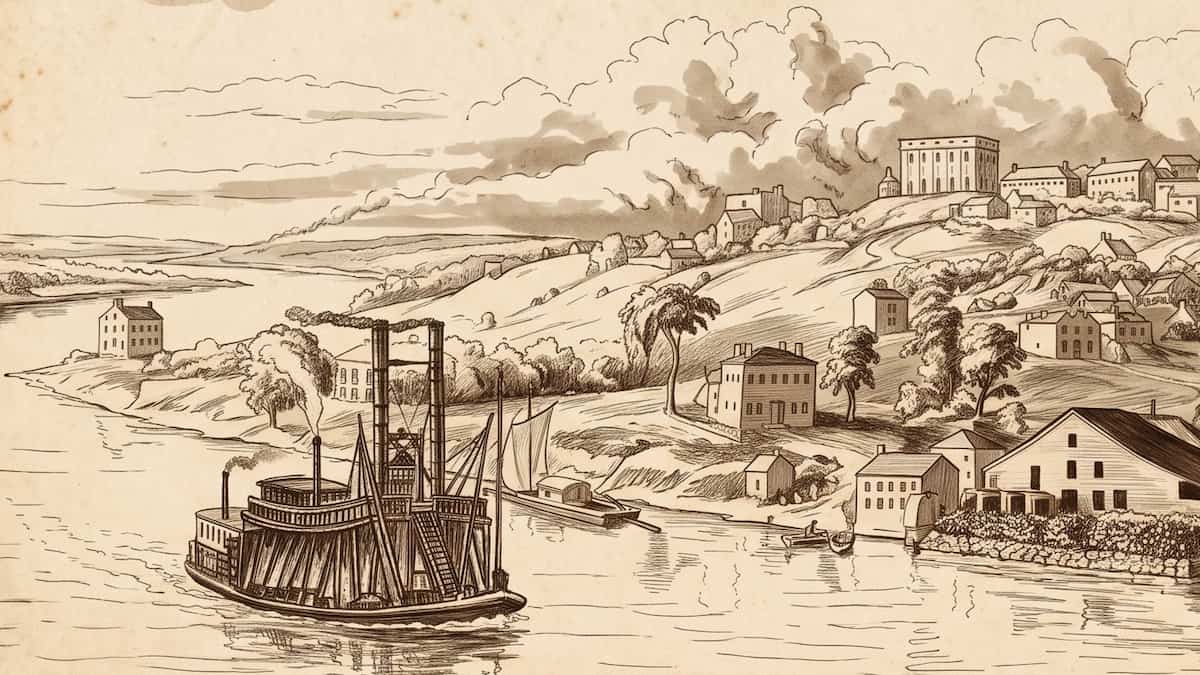
In brief, in September 1840, Joseph Smith and four other church members purchased a steamboat from the United States government for nearly $5,000. They renamed the boat the Nauvoo, but within months it crashed and was severely damaged. The men had purchased the boat hoping that they could pay it off with the proceeds from the boat’s business, but with it damaged and inoperable, they were unable to make the required payments. Joseph and the other investors attempted to recoup the money, but their efforts were largely unsuccessful.
In 1842, the United States federal government sued Joseph and his partners for repayment and won a judgment to recover the full purchase price. Rather than target all five men, government officials only sought to collect the sum from Joseph. However, attempts to collect the judgment were not successful, likely because Joseph claimed that he did not have enough personal property to settle the debt. There were attempts to settle this matter, but they were unresolved by the time of Joseph’s death.
After he was appointed as administrator of Joseph’s estate in 1848, Ferris published a list of property belonging to JS that he had identified—including some of the property Joseph had held as trustee for the church as well as properties that had belonged to Emma and her children—and advertised his intention to sell the property to pay Joseph’s debts. In response, the federal government came forward demanding payment for the 1842 judgment. In 1850, government officials sued the estate, the Smith family, people who had purchased property from Emma, and many Latter-day Saints who had lived in Nauvoo (most of whom were in Utah and ignorant of the proceedings) to recover the debt.
What were the final legal outcomes of Emma’s legal battles, and how did the financial losses on both sides fuel decades of bitterness between the Saints in Utah and the Smith family in Illinois?
The federal government’s lawsuit was ultimately a mixed bag for Emma Smith Bidamon. In 1852, the court issued its ruling, agreeing with Emma’s position that Joseph Smith held more property as church trustee than was allowed by law. However, the court also found that Emma did not have any special rights to Joseph’s property aside from those ordinarily held as a widow. Subsequently, most of the property Joseph or the Smith family had held or sold was seized and sold at auction to pay for the steamboat debt. As Joseph’s widow, Emma was granted ⅙ of the proceeds of these sales, totaling just over $1,800.
The federal government’s lawsuit was ultimately a mixed bag for Emma Smith Bidamon.
Meanwhile, local land speculator Phineas Kimball filed a separate lawsuit against Joseph Smith’s estate and family seeking payment for an old debt from the 1830s that had probably already been paid. This lawsuit resulted in the seizure of the Smith family property in Nauvoo, including the Nauvoo Mansion, and their farm located just outside of the city. Fortunately for Emma and her children, George Edmunds, a sympathetic local attorney, intervened and purchased and returned this property to Emma, in exchange for most of the proceeds Emma had earned from the federal lawsuit.
These legal battles inflicted considerable financial strain on Emma and her children throughout the late 1840s and 1850s. In his letters and later autobiography, Joseph Smith III made it clear that he blamed these struggles on Brigham Young and other church leaders in Utah.
For their part, however, Young and most church leaders in Utah were ignorant of these later lawsuits. To the best of their knowledge, church trustees had abandoned Nauvoo in 1848 after Emma successfully ended the church’s ability to conduct business in Illinois. As far as they knew, Emma had won control of the church’s property, while the bulk of the Saints suffered in Iowa or in crossing the plains. These misunderstandings and resentments played a significant role in the hostilities between the Utah church and the RLDS church in the second half of the 19th century.
Don’t Miss Our Latest Interviews!
Readers trust From the Desk for insightful interviews—Sign up to get the latest first.
About the Scholar
Jeffrey Mahas is a historian with the Church History Department of The Church of Jesus Christ of Latter-day Saints. His academic expertise focuses on the early history of the Latter-day Saint movement, with a particular emphasis on the Nauvoo era, nineteenth-century legal proceedings, and institutional finances. He was a key contributor to the landmark Joseph Smith Papers Project, where his archival research heavily shaped volumes across the Administrative, Documents, Legal, and Financial Records series. Holding a master’s degree in US history from the University of Utah, Mahas has further established his scholarly authority by publishing in academic compilations like Billions Shall Know Brother Joseph. This extensive background in primary sources uniquely positions him to untangle the historical realities driving the Emma Smith legal battles and the complex financial fallout regarding Joseph’s estate.
Further Reading
Explore more From the Desk articles about the aftermath of Joseph Smith’s death
- The Remarkable Legacy of Emma Smith
- What Led to Joseph Smith’s Death at Carthage?
- Who Was William Marks?
- How Have Community of Christ and The Church of Jesus Christ of Latter-day Saints Interacted in Nauvoo?
- What Is the ‘Six Days in August’ Movie?
Emma Smith’s Legal Battles
Read what top scholars and publishers say about Emma Smith’s legal battles over Joseph Smith’s Estate:
- Billions Shall Know Brother Joseph: The Joseph Smith Papers and Latter-day Saint History (BYU RSC and Deseret Book)
- Joseph Smith And Legal Process: In the Wake of The Steamboat Nauvoo (BYU Studies)
- Introduction to Steamboat Nauvoo (Joseph Smith Papers)
- Introduction to Joseph Smith’s Estate (Joseph Smith Papers)
- Settlement of Joseph Smith’s Estate (Church History Topics)

