
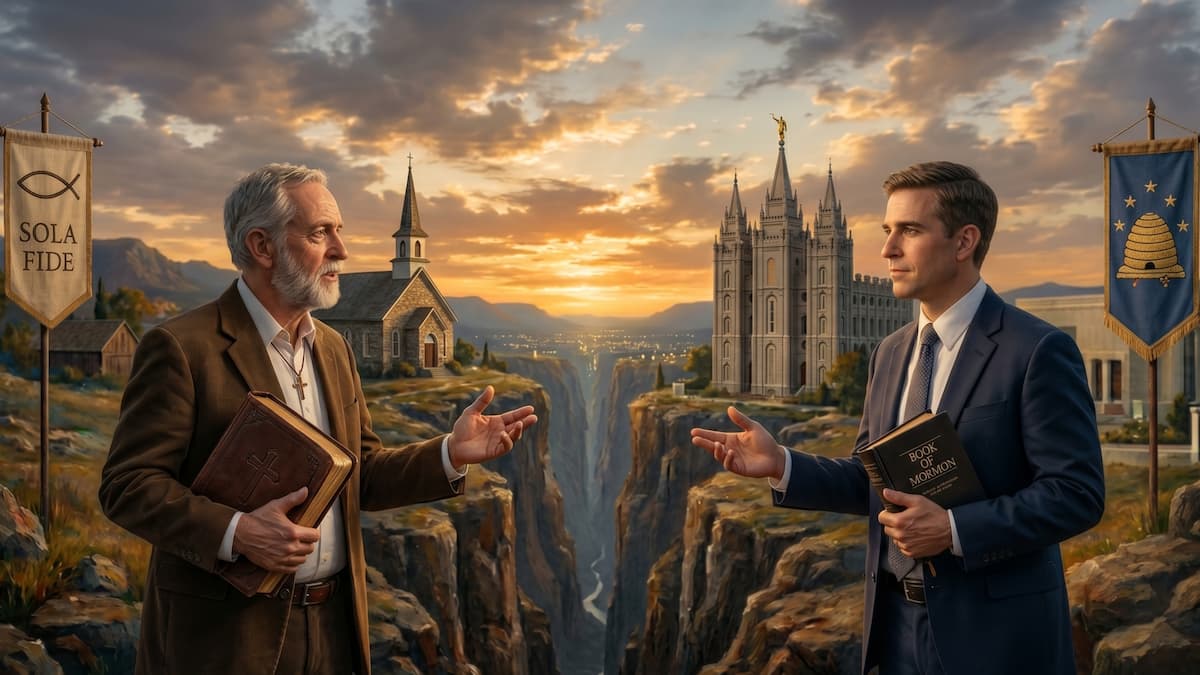
Evangelical Christians typically view Latter-day Saints as moral neighbors while holding that their distinct doctrines on the Godhead and salvation remain outside historic Christian orthodoxy. This theological divide creates a “Different Jesus” paradox where shared devotion to Christ’s life often masks fundamental disagreements over his nature and humanity’s eternal potential. Truly loving one’s neighbor requires navigating these boundaries—from the “prophet puzzle” of Joseph Smith to the restored authority of the priesthood—with clarity rather than caricature. In this interview, Baptist pastor Kyle Beshears discusses the research and conviction behind his book, 40 Questions About Mormonism.
Don’t miss new insights on topics such as Atonement Theory and the 1832 Account of the First Vision. Sign up to get them straight to your inbox.


“40 Questions About Mormonism”: A New Book That Supports Interfaith Dialogue
— Evangelical pastor and scholar Kyle Beshears wrote 40 Questions About Mormonism to provide an accessible, scholarly resource that moves beyond common religious caricatures to help Christians truly know and love their Latter-day Saint neighbors.
What is Kyle Beshears’s religious background, and why did he write a book about Latter-day Saint beliefs?
I am an evangelical (Baptist) pastor from Mobile, Alabama, where I’ve served a church since 2013. I’ve always been fascinated by Latter-day Saint history, and wrote my dissertation on James Strang’s church after his death.
During that process, I was approached by the publisher (Kregel Academic) about writing a volume on Mormonism in their popular 40 Questions About series. I’ve always wanted a resource on Latter-day Saint history, doctrine, and practices that was written from a traditional Christian perspective but was not a pragmatic evangelism guide or an overt work of apologetics. Instead, I wanted it to be an accessible, scholarly resource more at home in comparative or interfaith spaces. So, when the opportunity came to me, I thought, “Why not create that resource?”


Why do you think traditional Christians should try to learn more about and understand Mormonism and vice versa?
At the core of my conviction is this: since all Christians are called by Christ to the Greatest Commandment–the second part of which calls us to “love your neighbor as yourself” (Mark 12:31)–then we should seek to understand our neighbors as part of loving them “as yourself.” If we truly desire to love our neighbor “as yourself,” then how can we if we don’t know anything about them? Or how can we if we think we know them, but it’s a caricature or an outright fictitious version of them? To love someone is to know them, and for traditional Christians to love their theological neighbors well, they must know them well.
For traditional Christians to love their theological neighbors well, they must know them well.
This may seem like a squishy, theologically-charged answer, but it’s my sincere conviction and primary motivation for writing the book. Every other reason–e.g., doctrinal, ethical, social–flows from there.
It is the same for Latter-day Saints learning about mainstream Christianity, but in the inverse.
What are some of the most common questions and misunderstandings traditional Christians have about Latter-day Saints?
Maybe the best way to answer this question is to list some of the common questions I get that, in and of themselves, reflect misunderstandings.
- Why do Mormons replace the Bible with the Book of Mormon?
- Why do Mormons worship Joseph Smith?
- Aren’t Mormons polygamists?
- Don’t Mormons think they’ll get their own planet when they die, and populate it with spirit babies with their polygamist wives?
- Why do Mormons wear secret magic underwear?
These questions are, from the perspective of a Latter-day Saint, very misguided and cringeworthy. Yet, they’re common among rank-and-file evangelicals with little to no connection to the Church of Jesus Christ of Latter-day Saints. Generally, though, I’ve found that when these questions are asked, they are coming from a deep deficit of knowledge but are well-meaning. The questions arise out of both curiosity and concern. Part of the reason I wrote the book was to train traditional Christians to ask better questions.
Are Mormons Christian? Core Beliefs That Evangelicals Find Distinctive
— Latter-day Saints fall outside the category of traditional Christianity because their distinct scriptural authorities and views on the nature of God—specifically regarding the Godhead and Christ’s origins—diverge from the classical Trinitarian and creedal foundations that define the historic Christian faith.
What are the four basic distinctives of Mormonism?
40 Questions About Mormonism is structured around basic distinctives of Mormonism: the story, authorities, doctrines, and practices.
First, the story of Mormonism tells of a young boy, Joseph Smith, encountering God the Father and the Son in a “First Vision,” and subsequently excavating ancient golden plates revealed by an angel. Joseph Smith miraculously translated the record as the Book of Mormon, the keystone text of LDS scripture and a scriptural companion to the Bible as another testament of Jesus Christ.
Second, the authorities. Accepting the Doctrine and Covenants and Pearl of Great Price alongside the Bible and Book of Mormon as the four standard works of their scriptural authority, Latter-day Saints adhere to the doctrine of continuing revelation through modern prophets and a restored priesthood authority originating with Joseph Smith, while also looking to family, conscience, and the Spirit for guidance.
Third, the doctrines. Mormonism diverges from classical Christian theism and defines God as a complex, quasi-material being who, alongside a Heavenly Mother, serves as the eternal parent to human spirits. These spirits are undergoing earthly probation in anticipation of varying degrees of exaltation within three eternal kingdoms, based on their faith and obedience.
Finally, for practices, Mormonism emphasizes the binding power of priesthood ordinances for the eternality of families. Latter-day Saints engage in sacred temple rituals, like sealings and baptism for the dead, alongside public worship and a conversionary process requiring faith in Jesus Christ, repentance, baptism, and the receipt of the Holy Ghost.
Each of these distinctives is unique to Mormonism when compared to traditional Christianity.
How do you classify traditional Christianity, and in what ways do Latter-day Saints fall outside of that category?
I define traditional Christianity as the faith that holds to four things:
- The Holy Bible alone as inspired Scripture (i.e., not the Book of Mormon, Doctrine and Covenants, nor Pearl of Great Price)
- The ecumenical creeds (e.g., Apostles’ Creed, Nicene Creed, Athanasian Creed)
- The classical Trinitarian person and work of God
- The practice of ethical teachings and spiritual imperatives from God
This definition is not meant to be a polemic or apologetic argument; rather, it is simply an observation about what unites traditional Christians (Eastern Orthodox, Roman Catholic, Protestant, etc.) in distinction from Latter-day Saints.
There are some commonalities in this definition, particularly the fourth classification. To a certain extent, Latter-day Saints also affirm elements of the ancient Christian creeds (though the creeds themselves have no authority). However, because traditional Christians do not accept the additional texts of the Latter-day Saint Standard Works and hold to classical Trinitarianism, Latter-day Saints fall outside the definition of “traditional” Christianity. As I point out, though, being outside traditional Christianity was, in essence, the natural and inevitable result of the First Vision.

How does the Latter-day Saint Godhead differ from the traditional Christian Trinity?
At face value, there doesn’t seem to be much difference. All Christians believe in God Almighty, who is Father, Son, and Holy Spirit (or Holy Ghost). One God, three persons. The question then becomes, how is one God three persons?
For traditional Christians, the answer begins with the oneness of God, working out to His threeness. Trinitarianism teaches that God is one in nature but not in number. I defined the doctrine like this:
- There is only one God.
- God is a Trinity of Father, Son, and Holy Spirit.
- The Father, Son, and Holy Spirit are not the same persons.
- The Father, Son, and Holy Spirit are of the same divine Being.
- The Trinity is bound by common essence or nature.
For Latter-day Saints, however, the answer begins with the threeness of God and works into the oneness of the Godhead. Joseph Smith’s experience with the First Vision, I believe, has led to the strong conviction among Latter-day Saints that the Godhead is a community of three separate and distinct beings who are bound together by love and unity, not necessarily by essence or nature. So, I defined the Latter-day Saint Godhead thus:
- There is only one Godhead.
- The Godhead is a divine council of Father, Son, and Holy Ghost.
- The Father, Son, and Holy Ghost are not the same personages.
- The Father, Son, and Holy Ghost are not consubstantial.
- The members of the Godhead are bound by mutual love and harmonized will.
In the end, the difference stems from different convictions about the nature of God, i.e., what is God?
In what ways is it both rashly uncharitable and yet precisely true to say that Latter-day Saints worship an utterly different Jesus than traditional Christians?
Perhaps no other line from the book has garnered more attention than this one:
Claiming that Latter-day Saints worship an utterly different Jesus than traditional Christians is both rashly uncharitable and yet precisely true.
There’s a lot of agreement that, I think, traditional Christians tend to overlook. Mormonism affirms that he was truly human, born of the Virgin Mary and raised in Nazareth. He gathered twelve disciples, performed miracles, and preached repentance. He lived sinlessly, setting the ultimate example of holiness and human flourishing. The object of Christ’s life-giving ministry was paradoxically his sacrificial death for the atonement of the world’s sin. After three days in the tomb, Jesus was resurrected and later ascended to the Father, where he awaits his return to judge the living and the dead. These are excellent points of agreement because they have so much to do with the mission and work of Christ.
But there’s a lot of disagreement that, in my opinion, Latter-day Saints tend to want to minimize. Jesus is the offspring of God the Father and Heavenly Mother as their firstborn child, and our eldest spirit brother. His membership in the Godhead is not timeless but began after his ascent to godhood by personal progression. These are very serious disagreements about Christ’s nature.
These are very serious disagreements about Christ’s nature.
In the end, I think traditional Christians would do well to contemplate what we have in common here, and that Latter-day Saints would do well to consider why, given the differences, we tend to hold each other at arm’s length. The nature of Christ is a really big deal to traditional Christians–whole councils were called over it–so it’s a very important facet of our theology and worship.
Prophets, Priesthood, and Salvation: Other Distinctive Latter-day Saint Beliefs
— Kyle Beshears examines the complexity of Joseph Smith’s legacy through the “prophet puzzle,” the central role of the priesthood as literal divine authority, and the theological nuances of salvation, particularly the Latter-day Saint focus on exaltation and eternal marriage.
What is the “prophet puzzle,” and why is it important?
The term was coined by historian Jan Shipps, who used it to say, essentially, that there is a mystery to Joseph Smith that cannot be solved with either hagiographic or critical interpretations of his life. Consequently, without solving first the “prophet puzzle,” the mysteries of Mormonism will remain so. This concept is important because it resists the hagiographic-critical binary we tend to be drawn toward when viewing Joseph Smith.

So, as a personal example, I do not believe Joseph Smith was a prophet, and with my background, one would suspect I align with a strictly critical view of him. Indeed, before writing this book, I harbored a suspicion that, perhaps, he was a pious fraud. But after getting to know him through the Joseph Smith Papers, something different emerged. As a pastor, I couldn’t help but notice a pastoral side to Joseph. I’m still not quite sure what to do with Joseph–I’ve not figured out the prophet puzzle–but I’ve abandoned the assumption that he did everything deceptively (whether intentional or not) for purely selfish reasons.
In what ways is the Latter-day Saint priesthood perhaps the most essential yet least understood element of Mormonism?
For traditional Christians, when we hear the word “priesthood,” our minds are immediately whisked away to the Old Testament–Aaron, Levites, tabernacle, sacrifices–and, for some, to the professional clergy class that serves them. Especially for Protestants, the “priesthood” is a thing fulfilled, something in the past and remembered mainly as participation in the activity of God for all Christians, i.e., the priesthood of all believers.
No matter where you look in Mormonism, you’ll find the priesthood.
So, when traditional Christians hear a Latter-day Saint talk about the priesthood, they initially overlay their concept on the term. But, as the conversation continues, it quickly becomes apparent that we mean very different things. The priesthood in Mormonism is the power and authority of God to act in His accordance. Baptism, the gift of the Holy Ghost, saving ordinances, sealing power, ecclesiastical offices, and even salvation itself are powerless without it. No matter where you look in Mormonism, you’ll find the priesthood. That’s quite a different thing from traditional Christianity. In my opinion, the priesthood is the most important and least understood element of Mormonism among traditional Christians.
What are some of the differences in vocabulary about salvation between Latter-day Saints and traditional Christians, and why are the distinctions important?
Because both traditional Christians and Latter-day Saints are people who believe in the saving work of God in the lives of people, I think salvation language deserves our greatest attention. What does it mean to have faith, to be saved, or to be sanctified? The way we define these terms inevitably shapes how we understand salvation.
Take, for example, the terms glorification and exaltation. Generally, traditional Christians believe glorification is God’s work of redemption to bring about complete holiness in all His saints, whereby His image is completely restored in them, and they dwell eternally in the direct presence of the Father, Son, and Holy Spirit forever.
Latter-day Saints prefer the term exaltation, which means the culmination of God’s plan of salvation for humankind to bring about complete holiness in His faithful and righteous saints, whereby they are completely transformed to be like Him through sealing ordinances, especially marriage, and dwell eternally in the direct presence of the Father, Son, and Holy Ghost.
Note that, for traditional Christians, marriage is not an anticipated element of their glorification; whereas, for Latter-day Saints, it is an eternal covenant carried on in exaltation.
Neighborly Love and Convictional Civility: Final Takeaways from “40 Questions About Mormonism”
— Kyle Beshears intends for his book to model a charitable and transparent approach to interfaith dialogue that helps traditional Christians understand their neighbors accurately while providing Latter-day Saints with an outsider’s perspective on their own doctrines and practices.
What do you believe that mainstream Christians and Latter-day Saints could gain from reading 40 Questions About Mormonism?
Of course, I hope readers gain valuable information, especially traditional Christians who know little or nothing about Mormonism. If I could be their first non-LDS introduction to Mormonism, I would be delighted. And I hope that Latter-day Saint readers can gain new insight, too. Maybe they learn something they didn’t know, but more importantly, they see how their story, doctrines, and practices are seen by a charitable outsider.
In the end, I hope to model a better mode of approaching Mormonism as a traditional Christian. Readers will note that this book is not a polemic nor a pragmatic evangelism guide. Yet, I also don’t shy away from differences, especially ones I find to be severe, e.g., the fall or the Great Apostasy. Still, how we discuss differences is just as important as what we discuss, so I hope I’ve modeled a irenic, charitable, and clear way to get to know one’s Latter-day Saint neighbor better.
Don’t Miss Our Latest Interviews!
Be the first to read our latest in-depth interviews.
About the Scholar
Kyle Beshears is the Associate Dean of the School of Christian Studies at the University of Mobile and serves as a teaching pastor at Mars Hill Church in Mobile, Alabama. Specializing in world religions and 19th-century history, his academic research focuses on the historical evolution and theological distinctives within the broader Latter-day Saint movement. He is the author of 40 Questions About Mormonism (2026), a scholarly volume designed to provide a clear, accessible framework for comparative dialogue between Mormons and Evangelicals. A graduate of The Southern Baptist Theological Seminary and a Navy Reserve Chaplain, Beshears also serves on the board of the John Whitmer Historical Association, highlighting his commitment to rigorous historical inquiry. His background as both a credentialed historian and a local pastor allows him to navigate deep doctrinal disagreements with a unique combination of critical transparency and neighborly charity.
Further Reading
Explore more From the Desk articles about mainstream Christianity and The Church of Jesus Christ of Latter-day Saints
- What Did Bob Millet Learn From Interfaith Leaders Like Rich Mouw?
- Why Did Eerdmans Publish a Book on Latter-day Saint Theology?
- How Do Latter-day Saints Approach Biblical Theology?
- Does the Book of Mormon Reinterpret the Bible?
- How Does the Sacrament Compare to the Eucharist?
Evangelicals and Mormons
Read what top scholars and publishers say about how evangelical Christians think about Mormonism:
- 40 Questions About Mormonism (Kregel Academic)
- A Review: 40 Questions About Mormonism (Times and Seasons)
- Condescension and Fullness: LDS Christology in Conversation with Historic Christianity (BYU Religious Studies Center)
- Mormons and Evangelicals: Answering the Hardball Questions (Religion News)

