
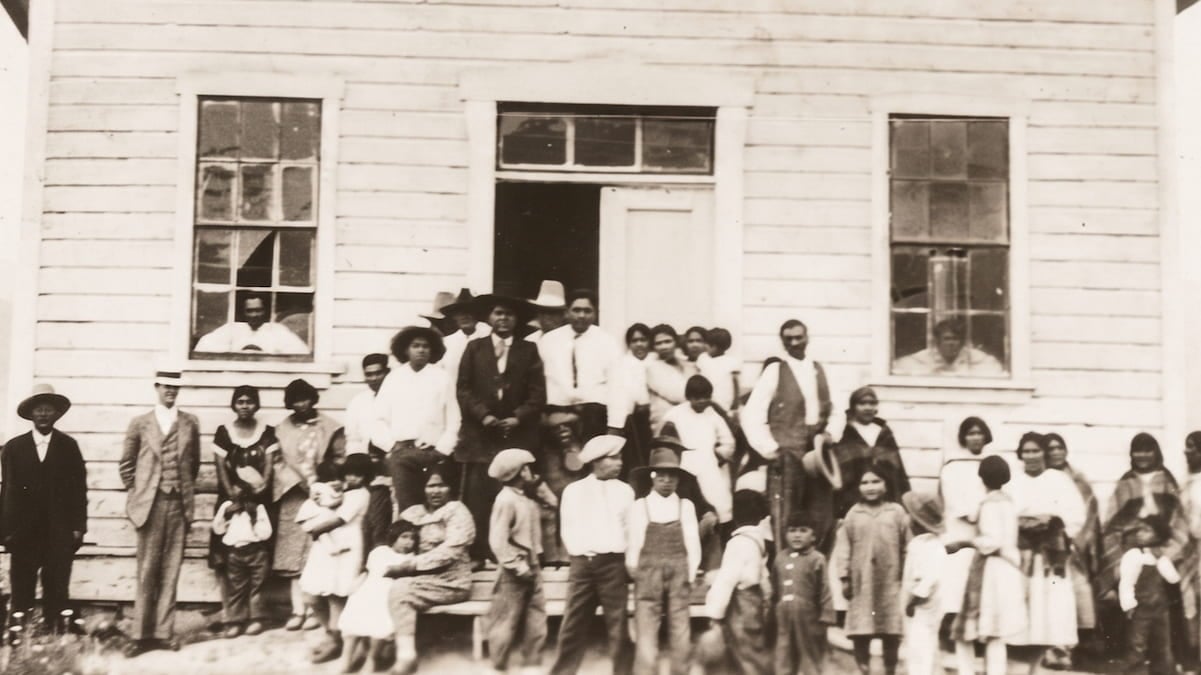
Native Saints: The Washakie Ward is a new digital history resource documenting the resilient lives of Northwestern Shoshone converts who established a thriving farming community in northern Utah. During the 1870s, after some spiritual manifestations, these Shoshone requested that Latter-day Saint missionaries visit them, and they were soon baptized. At Washakie, they built a ward that preserved their language and heritage through indigenous leadership and record-keeping. This history traces their journey from spiritual visions to the tragic 1969 burning of their homes and modern efforts toward land restoration. In this interview, historian David Grua explains how collaboration with tribal elders helped recover these vital stories of faith.
Don’t miss new insights on topics such as Wakara and the Mountain Meadows Massacre. Sign up to get them straight to your inbox.


Native Saints
— Native Saints: The Washakie Ward is a collaborative digital history resource documenting the 1880–1966 Northwestern Shoshone congregation through a partnership between the Church History Department and tribal leaders.
What is Native Saints: The Washakie Ward?
It is a digital history resource that tells the story of the Washakie Ward, a Northwestern Shoshone congregation of the Church of Jesus Christ of Latter-day Saints that operated in northern Utah between 1880 and 1966. It is a collaboration between the Church History Department and the federally recognized Northwestern Band of the Shoshone Nation.
The resource is published through the Church Historians Press website and includes the following:
- Historical essays detailing the tribe’s relationship with the church
- Biographies of key community members
- Maps, photographs, and other supplementary materials
In addition, the Church History Biographical Database includes a digital database of community members whose names appear in missionary and congregational records through 1940.


Why is the Church interested in this project?
Native Saints: The Washakie Ward is, in some ways, an outgrowth of volume 2 of Saints: The Story of the Church of Jesus Christ in the Latter Days. There were chapters in that volume that told the story of how the Northwestern Shoshone came into the church.
Saints made a concerted effort to map out the church’s global and diverse past, and that remains a core emphasis in the Church History Department today.
Native Saints: The Washakie Ward builds on an already-established relationship between the Church History Department and the Northwestern Band of the Shoshone Nation (NWBSN). Scott R. Christensen, a Church History Library archivist, acquisitions specialist, and author of Sagwitch: Shoshone Chieftain, Mormon Elder, 1822–1887, has been working with Northwestern Shoshone tribal elders since the 1980s.
About a decade ago, the Church History Library entered into a record-sharing agreement that facilitates the sharing of digital scans of the CHL’s holdings related to the tribe with the Northwestern Band’s digital archive, hosted by Utah State University.
How did the Northwestern Band of the Shoshone Nation become involved in this project?
Native Saints: The Washakie Ward continues that spirit of collaboration. In late 2023, Scott Christensen introduced my colleague Jeffrey Mahas and me to NWBSN History and Culture Specialist Patty Timbimboo-Madsen, Cultural Advisor Rios Pacheco, and Vice Chairman Bradley Parry at the tribe’s headquarters in Ogden, Utah. For the next two and a half years, we met regularly to share research, develop the project, and review pre-publication drafts of essays and biographies. These sessions were often four hours or more, but the subject matter was so engaging that we barely felt the time pass.
Our relationship has been built on reciprocity, a foundational Shoshone and Indigenous cultural value, as we shared meals, visited the historic Washakie chapel and cemetery with the tribal elders and our team of missionaries, attended the tribe’s annual Gathering of Remembrance memorial service at the Bear River Massacre site, and helped with the NWBSN’s ongoing reclamation project as part of the Wuda Ogwa Tree-Planting Days. Native Saints: The Washakie Ward has been as much about relationship building as it has been about research.
The Church and the Shoshone
— Spiritual manifestations following the 1863 Bear River Massacre led survivors like Chief Sagwitch to join the Church.
How has the attitude of Church leadership towards the Native American population evolved over the past 200 years?
The church’s history with Native peoples over the past two centuries is a complicated subject that could take volumes to unpack. But I’ll try to give a succinct answer here.
Beginning in 1830, Euro-American Latter-day Saints understood Indigenous people as descendants of the Lamanites, ancient Israelites described in the Book of Mormon. This belief led to a special affinity toward Natives as well as waves of proselytizing as white Saints moved West.
The move to the Great Basin ensured that these efforts became entangled in the Saints’ colonization of the region, as expansion produced competition and violence with Natives for land and resources. But there was also cooperation, and many Native peoples, including Sagwitch’s Northwestern Shoshone, came to trust Euro-American Latter-day Saints more than they did the federal government, which, combined with spiritual manifestations, led thousands of Indigenous peoples to join the church.
Like other Euro-Americans, Latter-day Saints held paternalistic attitudes toward Native peoples, leading to efforts in the nineteenth century to bring Indigenous children into white homes, to establish farming communities for Native converts like Washakie, and later to form the Indian Student Placement Program.
Since the dissolution of the ISPP in the late twentieth century, church leaders have tended to engage Indigenous peoples as members of tribal nations, allowing Native members to embrace (or reject) a Lamanite identity on their own terms.
What does the Bear River Massacre of 1863 have to do with the release of this trove of information?
On 29 January 1863, U.S. Volunteers under the command of Colonel Patrick Edward Connor attacked a Northwestern Shoshone winter camp on the Bear River near Franklin, Idaho, at dawn, killing more than 300 men, women, and children. It is considered by many scholars to be the largest massacre of Native peoples by United States troops in American history.
Sagwitch and other massacre survivors were deeply traumatized by the attack and struggled to survive over the next decade. When federal agents began pressuring the Northwestern Shoshone to relocate to the Fort Hall reservation in southeastern Idaho, they instead chose to remain in their homeland among the Latter-day Saint settlements.


What led the surviving tribal leaders to contact and later join the church?
During the summer of 1872, Sagwitch, his cousin, Ech-up-wy—later known as John Moemberg—and their extended families were camping together west of the Salt Lake Valley. They later reported that “three strange men … [who] were evidently Indians” appeared at their tent.
They told the Shoshone leaders that they should be baptized as Latter-day Saints and adopt Euro-American methods of agriculture, after which the Shoshone leaders had visions of their people farming and living in houses in northern Utah. Sagwitch and Ech-up-wy presumably understood this as a manifestation of bo’ha, or spiritual power, and the three visitors as spirit guides; their descendants would later interpret the experience as a visitation of the Three Nephites of the Book of Mormon.
In any case, after the men left, Sagwitch and Ech-up-wy communicated with Brigham Young as well as Euro-American missionary George Washington Hill, a fluent Shoshone-speaker who was known to them, who baptized Sagwitch, Ech-up-wy, and about 100 other Shoshone in the Bear River on 5 May 1873. Over the next two years, Hill baptized nearly 1,000 Shoshone from Wyoming, Idaho, and northern Utah.
Without a Shoshone Book of Mormon translation, what method was used to teach the Native Americans?
Initially, instruction was oral preaching. Unfortunately, we don’t have detailed summaries of George Washington Hill’s sermons, but presumably he taught them about Jesus, the scriptures, and prophets in language and metaphors that the Shoshone would understand.
At some point, C.C.A. Christensen created a panorama of scenes from the Bible and Book of Mormon that was evidently used by Hill and Dimick B. Huntington to teach new Shoshone converts. The Book of Mormon was an important tool of conversion, not because the Shoshone could read the text, but because the stories in the book resonated with them.
How was the gospel message received among the Shoshone people?
George Washington Hill wrote in August 1876, just three years after the initial baptisms, that the Shoshone converts “attend well to meeting and some of them understand themselves very well in fact are very good preachers they some of them full sense the situation they say they understand mormonism now and like it well.”
The following month, Brigham Young wrote of the Shoshone Saints that their “teachers are of their own people and they hold their meetings and pray and preach as intelligently as their white brethren.”
It was around this time that Sagwitch’s cousin, Ech-up-wy, came to be known as “Bishop John” among whites and Shoshone alike. Although he was not a bishop ecclesiastically, the honorific paints a picture of his religious leadership in the community.
Washakie
— The Washakie community enabled Northwestern Shoshone Saints to preserve their culture through indigenous leadership and Shoshone-language worship before the town’s tragic 1972 destruction eventually led to the restoration of tribal land.
Why did the church help establish a community for the new converts, rather than just have them live on the federal government reservations?
The federal reservation system in the nineteenth century had close ties with Protestant denominations, who maintained deep suspicions of the Latter-day Saints. In short, Latter-day Saints were excluded from this system and were, by and large, not permitted to preach on reservations.
At the same time, many Great Basin Natives had concluded that adopting Euro-American methods of agriculture would be essential to their survival, and they believed, correctly, that Latter-day Saints would be more than willing to help them acquire homesteads within their homelands and necessary farming equipment.
Why did they choose the name “Washakie” for their community?
The name was likely chosen to honor Washakie, the Eastern Shoshone chief who was seen as the paramount leader of the broader Shoshone Nation.


Who were the early Euro-American leaders who helped establish the community and ward?
We’ve already discussed George Washington Hill, who played such a key role in the community’s conversion. Over time, more missionaries were called, including Isaac E. D. Zundel, who served as the first Euro-American bishop of the Washakie Ward between 1880 and 1890. Isaac’s wife, Elizabeth Jane Harding Zundel, was called as the first Euro-American Relief Society president in the ward in 1883.
The Ward family also made a significant contribution to the community during the early years, with Moroni and Eliza Voss Ward replacing the Zundels as bishop and Relief Society president during the 1890s. Their son, George Moroni Ward, who was raised at Washakie, served for 27 years as bishop in the early twentieth century, and his wife, Mary Ann Morgan Ward, was the Relief Society president.
These individuals shared many of the racial and cultural assumptions of their contemporaries, but they were also dedicated Latter-day Saints who committed their lives to serving the Shoshone Saints at Washakie.
What were some of the “Firsts” among these Saints?
Although Euro-American missionary couples filled most of the ward leadership positions during the congregation’s earliest years, there was a concerted effort to promote Shoshone individuals into leadership.
There was a concerted effort to promote Shoshone individuals into leadership.
Cohn Shoshonitz Zundel, the daughter of prominent Northwestern Shoshone Latter-day Saints and massacre survivors, was called in 1883 to serve as a counselor in Elizabeth Zundel’s Relief Society presidency. She was the first Northwestern Shoshone to serve in a ward leadership calling.
Her husband, Moroni Zundel (a Northwestern Shoshone who adopted the Zundel surname) was appointed as the ward’s first Native Sunday School superintendent in 1890, and within a few years the entire superintendency—including the clerk, Willie Ottogary, who was educated at the day school—was Shoshone.
Sagwitch’s son Yeager Timbimboo was called to serve as the ward’s first Shoshone Young Men’s Mutual Improvement Association superintendent in 1891—he would not be released from the calling for another thirty-six years—and in 1908 he was sustained as first counselor to Bishop Moroni Ward.
Yeager’s son Moroni Timbimboo was born at Washakie in 1888, and he served simultaneously as Sunday School superintendent and as ward clerk from 1913 until 1929, when he replaced his father in the bishopric. Moroni became the ward’s first Northwestern Shoshone bishop in 1939, while that same year Rhoda Moemberg Woonsook—great-granddaughter of community founder John Moemberg—served as the Washakie Ward’s first Northwestern Shoshone Relief Society president.
How would you characterize the faithfulness of these Native Saints?
The Washakie Shoshone were deeply committed Latter-day Saints. They donated their labor to help build the Logan Temple in the late 1870s and early 1880s, and the Logan Temple remained a sacred and special edifice for them as a people.
Their membership in the church was central to their community life and their lived experience as Native Saints. In 1922, they were recognized for paying 100% tithing. And even after many left Washakie in search of employment in the 1930s and 1940s (more on that below), they remained dedicated Latter-day Saints in other congregations.
How have the tribal customs and culture been retained, or relinquished, because of their conversion to the gospel?
Washakie was the place where the Northwestern Shoshone Latter-day Saints preserved their language, culture, and history and passed it on to their children. Worship services were conducted largely in Shoshone well into the twentieth century. Shoshone tribal elders taught their children the stories of their people at Washakie, while traditional medicinal and marital practices remained commonplace with minimal interference from white leadership.
From an early age, Shoshone children educated at the Washakie Day School employed their literacy in the service of their people. Willie Ottogary, his brother-in-law, Ammon Pubigee, and Lucy Zundel Alex (the daughter of Cohn Shoshonitz and Moroni Zundel) were just three of several Shoshone who served as clerks charged with creating and maintaining the congregational records that later served as a key foundation of Native Saints: The Washakie Ward.
In the 1910s, Ottogary began researching the 1863 Treaty of Box Elder, and he initiated a tradition of treaty-rights activism that has shaped Northwestern Shoshone political history. Children raised at Washakie also used the literacy they acquired at the day school to record their stories.
For example, Mae Timbimboo Parry recorded the stories she heard from her grandfather, Yeager Timbimboo, ensuring that their culture, history, and language would survive.

How large did the community of Washakie become, and how did it end?
By summer 1875, there was a bustling community of more than 1,000 Shoshone and Bannock Latter-day Saints living outside of Bear River City in northern Utah. Most had left the Wind River and Fort Hall reservations in search of food and decided to visit their relatives in northern Utah, where they heard Hill preach and accepted baptism.
Tragically, the rapid growth of the Native population alarmed the nearby non-Latter-day Saint town of Corinne. Believing incorrectly that Hill was going to lead the Natives in an attack on the town, the Corinne residents asked the territorial governor to send the military to disperse them, which occurred. The vast majority returned to the Wind River and Fort Hall reservations, although Sagwitch’s band remained and continued its efforts to establish a viable farming community.
When they formed the Washakie community in 1880, there were 200 Shoshone Saints on church rolls, as well as an unknown number of children under the age of 8. This number slowly fell in subsequent decades, with the decline due to the spread of infectious diseases and outmigration. By 1939, the number of ward members stood at 100.
As was happening among Native peoples elsewhere in the United States, Washakie residents were drawn to Ogden and other cities in search of employment in the defense industry during the Great Depression and World War II, and by 1960, the congregation was reclassified as a branch and then closed in 1966.
Many who were living elsewhere due to employment nevertheless saw Washakie as home, and the church misapprehended the Shoshone Saints’ attachment to the place, leading to the tragic decision to sell the farm (including the townsite) in 1972. As they prepared the land for sale, local church leaders—believing incorrectly that the Shoshone Saints had all moved elsewhere—directed that homes be burned, a traumatic experience that continues to reverberate among descendants today.
After community members testified before church leaders about their losses, church leaders, including Apostle Spencer W. Kimball, donated 184 acres of land in Box Elder County to the tribe, which helped fulfill federal requirements to receive government aid and furthered the nation’s efforts to organize under a constitution in 1987.
Final Thoughts
— The Native Saints project aims to empower Shoshone descendants while providing scholars with a more nuanced understanding of how Indigenous people have shaped and engaged with Latter-day Saint history.
What do you hope will be accomplished by the publishing of this information about Native converts to the church?
We hope that Native Saints: The Washakie Ward will be useful for the descendants of the Washakie Saints and tribal members today.
Beyond the Northwestern Shoshone community, we hope that the general membership of the church, in particular Native Saints from other tribal nations, will find inspiration from these stories of Washakie.
And finally, we hope that scholars of Native Christianity and Mormon history will find in this resource a more nuanced picture of how Indigenous people have engaged with the Latter-day Saint religion throughout its history.
Citation Information: This post was originally published on May 31, 2025. The most recent update on June 25, 2026, includes updated resources and an improved online reading experience.
Don’t Miss Our Latest Interviews!
Be the first to read our latest in-depth interviews.
About the Scholar
David W. Grua is a Senior Historian in the Church History Department of the Church of Jesus Christ of Latter-day Saints and the Lead Historian of Native Saints: The Washakie Ward. He previously worked as a historian on the Joseph Smith Papers. David holds a Ph.D. in American History from Texas Christian University as well as degrees in history from Brigham Young University. He is the author of the award-winning Surviving Wounded Knee: The Lakotas and Politics of Memory (Oxford University Press, 2016).
Further Reading
Explore more From the Desk articles about Native Americans and Latter-day Saints
- Global Mormonism: Latter-day Saints Around the World
- Who Are the Navajo Latter-day Saints?
- Who Was Chief Wakara?
- How Did Race Factor into Pioneer-Era Latter-day Saint Settlement and Missionary Work?
- Who Was Jacob Hamblin?
Shoshone Latter-day Saints
Read what top scholars and publishers say about Shoshone Latter-day Saints:
- Native Saints (Church Historian’s Press)
- Northwestern Band of the Shoshone Nation (Tribal Website)
- Shoshone Community Builders in the Washakie Ward (Church Historian’s Press)
- Sagwitch (Church History Topics)
- About the Native Saints Dataset (Church History Biographical Database)

