
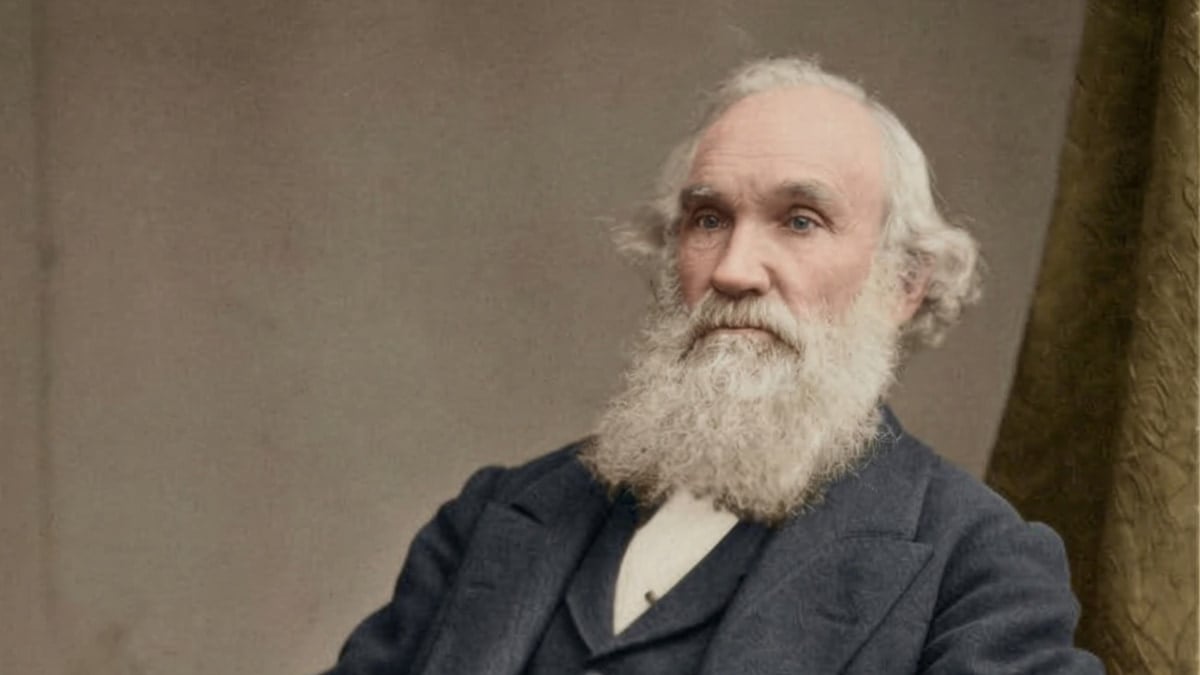
John Steele was an Irish-born Mormon Battalion member, pioneer physician, and influential militia leader who helped settle the high deserts of Southern Utah. Raised by a Waterloo veteran, Steele navigated the frontier with a rigid military discipline that often blurred the lines between civic duty and religious enforcement. Whether practicing folk magic and herbal medicine or commanding southern Utah troops during the Utah War or the Black Hawk War, Steele’s life reveals the gritty complexities of building a self-sufficient “Mormon Kingdom” through absolute obedience. In this interview, Kerry William Bate explores the irascible spirit of a man who was as much a dedicated explorer as he was a “thrasher” of dissent.
Don’t miss new insights on topics such as Zerah Pulsipher and What Really Happened Between Jim Bridger and Brigham Young. Sign up to get them straight to your inbox.


John Steele: Overview and the Nauvoo Legion
— A small but formidable figure, John Steele carried a strict military upbringing from Ireland into the Nauvoo Legion, where his authoritarian temperament and tactical experience made him a feared officer in Utah’s early territorial wars.
Who was John Steele?
“This irascible old pepper box this Irish midge no bigger than a pint o soap after a hard day’s wash took no sass from anybody big or little, just itched for a fight and when he saw a scrap begged for permission to get into it!” was how newspaperman Frank A. Beckwith described Steele.
There’s some truth to Beckwith’s description. John Steele Jr., Protestant Irishman, stood about five feet, six inches tall and weighed around 130 pounds. His personality was heavily influenced by his elderly father, a retired soldier, and one suspects Steele conflated that man with God when he wrote, “The Lord has his own way of punishing his Children he uses the Rod to make them learn whare they Stand and to whip them into Subjection as we would do a fractious Horse.”
Steele was so frightening to ‘outsiders’ that a doctor who examined him for a potential pension increase wrote federal authorities, “He is a Mormon and in this part of the country my wellfare and life would scarcely be safe, should he know of the nature of the report.” He was accused of murdering or being complicit in the murder of a member of John C. Freemont’s Fifth Expedition. The family folklore of one man who fled Utah was also that John Steele and John D. Lee had tried to arrange his assassination before he got away. Steele’s name was even borrowed by a Christian novelist as the fictional leader of the Mountain Meadows Massacre.


What was Steele’s military background, and how did it shape his involvement in Latter-day Saint militias?
John Steele Sr. was a brown-haired, gray-eyed linen weaver when he joined the Downshire Militia, so poorly led that a British general who inspected them complained they were “formidable to everyone but the enemy.” In the 1798 Irish Rebellion, he and his loyalist comrades slaughtered men, women, and children and burned the Enniscorthy hospital and the patients trapped inside. He was taken with soldiering and joined the Third Battalion, Royal Scots, where he got better training and was eventually at Waterloo; he retired in 1816—“woarn out”—remarried, and his son John Jr. was born in 1821, when his father was 47. Failing to get a position as a Belfast police officer, the older man tended to his cows, hogs, poultry, and farm.
Years later, the younger Steele’s great-granddaughter, who knew and heard stories from John Jr.’s daughter, recalled his childhood training: he was “brought up as a military man. You was strict with what you done. You done exactly what they said,” summing up his authoritarian philosophy as “You do as they say!” This was the background to his experiences in the Mormon Battalion and his rapid promotions in the Utah Territorial Militia (the Nauvoo Legion), where he was an officer in the Walker and the Utah Black Hawk wars.
What was the Nauvoo Legion, and what role did it play in Steele’s life?
The Nauvoo Legion was a military unit organized by Joseph Smith to protect Nauvoo, Illinois. It became his personal army and was a source of fear and contention with neighboring communities.
The Nauvoo Legion was a source of fear and contention with neighboring communities.
On September 12, 1845, Steele was enrolled in the Legion and, within weeks, joined others to protect carding mills in the outlying town of Macedonia. As he was loading powder to defend against anti-Mormon night riders, he wrote, he remembered that when he was a boy, his father used a cane to train him in military maneuvers. His Macedonia adventure turned out to be anti-climactic, but it brought him satisfaction because the “mobocrats” were frightened into retreat by exaggerated reports of the strength of their adversaries.
This was a prelude to enrolling in the Mormon Battalion, when he spent a year on the march, bivouacking, and practicing military drills. Like many Battalion members, that gave him a leg up when the Nauvoo Legion was reorganized in Utah. Then he was chosen as a third lieutenant. Joining the Iron County Mission in 1850, he became lieutenant, moved up to captain, and became major by late 1853 (though his commission wasn’t signed until January 1854). The troops he trained were once reviewed by Col. James C. Fremont, who is reported, on slight authority, to have admired their unity and said, “if I had five thousand men like those I saw on drill today, I could march through Mexico, and with ten thousand, I could conquer Mexico.”
Steele was active in the misnamed Walker War, leading troops and tracking marauders. When the Legion was reorganized in 1864, he was elected major of a battalion based in Kane (now Washington) County, ensuring himself a significant role in the “Black Hawk” War.
The Mormon Battalion and the Mexican-American War
— Despite their initial resentment toward the government that had recently expelled them, John Steele and hundreds of others joined the Mormon Battalion to secure resources and political leverage, though Steele’s personal journey was marked by a defiant detour to Pueblo to protect his family.
Why did the U.S. government work to enlist Latter-day Saints in the war with Mexico?
During their expulsion from Illinois, the Mormons’ Washington, D.C. lobbyists insinuated that without government help, they would collude with the British—tensions were still high over Oregon—while also claiming their American loyalty. President Polk ordered five hundred Mormons be enlisted, though the Army had more volunteers than it needed. It was politic and humane, and was intended, not entirely successfully, to ensure there wouldn’t be a disgruntled ‘fifth column’ in the west.
Why were Latter-day Saints wary of enlisting in the Mormon Battalion?
Steele’s comments on the offer to enlist in the Mexican War were typical of his fellow religionists: “You can better imagine my feelings than I can describe them. I must ask pardon for thinking or saying they may all go to hell together.” He blamed “the whole United States” for “those who have mobbed, robbed, plundered and destroyed us all the day long and now seek to enslave us to fight for them.”
He changed his mind because Brigham Young and several apostles “said it would all be overruled for the best, and the only thing left for was us to furnish 500 men and march against the Mexicans, and they would try what could be done to have us get the country of California for fighting for it, and also get us discharged with our guns and accoutrements.”
This worked out for him, for he left Council Bluffs almost penniless and a year later, when he rode into Salt Lake Valley, he recalled that he and his comrades now “looked like mountaineers, sunburned and weather beaten, mostly dressed in buckskin with fringes and porcupine quills, moccasins, Spanish saddles and spurs, Spanish bridles and jinglers at them, and long beards.” “If I looked in the glass for the young man who left the Bluffs a year ago, I would not have known myself. Went away afoot, came home riding a fine horse and receiving a hearty welcome and a ‘God bless you’ from the Lord’s ministers: was worth all we suffered.” The Battalion gave him a powerful network of fellow soldiers among the leading young men in his church and provided him with a US pension in old age.
Why did John Steele and some other members of the Battalion not continue to San Diego?
When the Battalion reached Santa Fe, their new commander, Philip St. George Cooke, saw the troops and unfit hangers-on he was to take through a roadless, dry desert. He chose to send the sick, women, and children to winter in Pueblo. John Steele and John Hess met with Cooke and objected to sending their wives to be protected only by a group of sick men. After a heated exchange, Cooke visited with the commander and then changed his orders, allowing husbands to accompany their wives to Pueblo. Steele and many of his compatriots spent the winter there in sullen rebellion against what they saw as the tyranny of Captain James Brown.
Want More Scholar Interviews in Your Inbox?
Stay connected with fresh content and scholarly insights every week.
Settling Parowan, Cedar City, and the Mountain Meadows Massacre
— As a leader in the Iron Mission, John Steele acted as a “thrasher” of dissent who systematically purged independent voices from southern Utah, creating a climate of absolute obedience that left no one in Cedar City to challenge the local authorities during the lead-up to the Mountain Meadows Massacre.
Why were people called to settle Parowan and Cedar City in southern Utah?
“Iron we need and we must have,” proclaimed Brigham Young. “We cannot well do without it, and have it we must, if we have to send to England for it. We have an abundance of the best quality of iron ore,” as southern Utah boasted untold tons of iron and coal. Young organized the “Iron Mission” to build a Pittsburgh for the Kingdom, but he had trouble getting volunteers, so he called specific men to go, including John Steele. The reluctance was so great that the Deseret News taunted, “You could all go if a mob were at your heels.”
Some months after establishing Parowan in early 1851, the iron mongers among them moved a few miles south to found Cedar City, the site of the iron works. The works eventually failed because, unknown to the proprietors, the local coal was too impure.
What was the Great Cattle Rebellion of 1853, and how did it influence the Mountain Meadows Massacre?
Most of the troubles the Mormons had in the Midwest were at least partly rooted in the actions of disgruntled Mormons. As Steele and his group were ready to enter Salt Lake Valley in 1847, he recorded in his journal that Apostle Amasa Lyman advised them, “We had got out from jentile persecution and now we would be troubled with Devils in our own midst.”
This, and his naturally authoritarian personality, made him keenly suspicious of those he saw as weak in the faith, and with his position as first counselor in the Parowan Stake presidency, he was alert to crush potential dissent. “This is truly the great thrashing-floor; you are the reapers in the field; we are the thrashers; the Perpetual Emigrating Fund is the means of bringing the sheaves into the garner.” The flail, he wrote, is “the word of the Lord, as revealed to us from the authorities… and truly many that come here, as soon as the flail strikes them, jump off the floor, and bolt for some other country.” Steele saw himself as the “thrasher,” the enforcer, because the constant flood of new converts meant no single person was essential to building the Mormon Kingdom.
In 1853, at the beginning of the so-called Walker Indian War, Apostle George A. Smith went through southern Utah to round up ‘surplus’ cattle to take to Salt Lake. Unlike the agricultural communities, the Cedar iron mongers, hungry, half-clothed, and poor, had no other wealth than their cattle. Their resistance was so intimidating that Smith and his militia camped a half mile from town because they didn’t feel safe any closer. The militia, under Majors John Steele and James Little, helped intimidate the rebels to back down, and after two tries, Smith left with the cattle. Local leaders were threatened with chains and decapitation; many were then court-martialed and fined.
At a conference afterward, John Steele, Elijah Newman, and William H. Dame all spoke “on the present condition of the Territory, our trials, blessings, &c and recommended those who could not stand it, to go to California or somewhere else.” Many left. Steele welcomed the expulsions. He wrote George A. Smith, “[W]e hope by next year that ma[n]y more of the same Class will turn their H[e]els to us as we do not want Whiners & Complainers & faultfinders amongst us defusing their Baneful influance among those who would otherwise do good.”
Where were the voices of those with the courage to challenge authority?
Four years later, Cedar City leaders organized the murder of the Fancher Party at Mountain Meadows. Where were the voices of those with the courage to challenge authority? Gone to California and other places, silenced when they were needed most.
To what extent was John Steele involved in the Mountain Meadows Massacre?
Steele was at one, if not two, conferences held in Parowan where Cedar City leader Isaac C. Haight tried to get authorization from his military superior, William H. Dame, to murder the Fancher Party. After-the-fact testimony suggests that neither of these conferences authorized the attack, but Haight inveigled Dame into approving it at a late-night private consultation.
What Steele’s stance was in the conferences is unknown, but he insisted Dame was responsible for the Massacre, which, for a military mind like his, was consistent with Dame giving ultimate authorization. Nevertheless, it was Steele’s enthusiasm for crushing dissent that helped rid the community of those who might have had the courage to challenge mass murder.
Utah’s Black Hawk War
— During Utah’s Black Hawk War, John Steele managed the essential logistics of supply and communication while struggling to adapt to the sophisticated guerrilla tactics and strategic intelligence of the multitribal Native American alliance.
What was Utah’s Black Hawk War?
The War (1865-1872) began in Sanpete County, where unresolved animosities on both sides triggered a territorial explosion. Black Hawk, whose name was actually Antonga, led a sophisticated multitribal and territorial alliance and a few renegade Whites who drove the Mormons out of the Sevier Valley and other outlining settlements and were soon making a living from stolen Mormon cattle and horses, particularly in southwestern Utah. The conflict continued after Antonga withdrew and even after his death. For those in Southern Utah, it turned into Navajo raiders coming every winter to decimate settlers’ herds.
How did the Native Americans prove more intelligent and cunning than Steele anticipated during the conflict?
Despite a lifelong fascination with America’s indigenous people, two missions to them, and many years of association, Steele was unfamiliar with how wily and versatile the “Black Hawk” marauders were. They divided into groups of two or three, sneaking in on foot to steal stock. Their tactics included cutting down and holding small trees while advancing toward Mormon stock, or hiding inside the hide and head and hoofs of gutted yearling calves to get into corrals.
Steele was unfamiliar with how wily and versatile the “Black Hawk” marauders were.
Steele had a blind spot regarding the Navajo role in the depredations and was convinced “[T]hey all prove to be pah utes and have been stealing all the time and laying the blame on the Navijoes.” He thought preaching to them was worthless and wrote that if there was any good in them, “I Cannot see it.” Steele eventually realized his mistake in blaming the Paiutes, and two gift-giving ceremonies were held to thank them for their assistance. Steele’s subsequent comments about Native people showed he’d learned something: “I have found many good traits of charracter among them; one is, true to their friends.”
What was John Steele’s specific role in the Black Hawk War?
Steele’s role was mostly in logistics and commissary, maybe the least exciting but most important parts of warfare. The details of the Black Hawk War in southern Utah can often be untangled from John Steele’s papers, for he kept a tidy bundle of dozens of penciled War telegrams—too often only partly dated or undated—in his trunk. These reflected requests to forward supplies, arms, equipment, tools—even paper—as well as soldiers. They also identified potential and actual trouble spots needing immediate attention. When, angry over what he perceived as a lack of respect, he sent his resignation as Major to Apostle and General Erastus Snow. The resignation was tactfully rejected.

Utopian Ideals and Exploring the West
— Driven by a vision of a self-sufficient Mormon “Kingdom,” John Steele combined his fervor for British utopian ideals and folk mysticism with rigorous exploration to map the resources and routes that would eventually help with the expansion of the American Southwest.
John Steele was a fervent believer in utopian ideals. How did his utopian background influence his efforts to build the Kingdom of God?
Perhaps partly in reaction to the impoverishment of the working classes by laissez-faire industrialization, visions of Utopia gripped Steele and many of his contemporaries in the mid-century United Kingdom. Glasgow Green, where he socialized, was entertained, and read, had competing Utopian missionaries, both religious and secular. Here he could hear about new ideas of organizing society, and from this smorgasbord he adopted teetotalism by joining the Rechabites, Chartism with its goals of universal male suffrage, the secret ballot, and other political reforms, and was intrigued by the Owenite socialists.
He read the Book of Mormon on the Green and embraced its messages of economic uplift—historian Leonard Arrington described it as “a document of profound social protest” and Mormon economic plans as “collectivism not tarred by the Marxist brush!” The Mormon Kingdom, preparing for Christ, was to be an autarky—a self-sufficient empire.
Once in the United States, he put all his energies into that Kingdom, including ‘thrashing’ out dissidents using the levers he had: his religious, military, and judicial ranks and community standing. He also contributed to the kingdom with occult practices like astrology, uroscopy, arithmancy (numerology), magic charms, crystal prophesying, resuscitating drowning victims, bone-setting, herbal and other folk medicine, interpreting dreams and visions; at eighty-two, he even got a diploma in hypnosis, an unusual contribution.
His Church directed the development of the Utah Territory on both the macro- and micro-level, acting as a Community Development organization. They directed capital to needed efforts, including locating settlements, funding emigration, irrigation, dam-building, and, when necessary, resettlement, as well as schemes as varied as territorial railroads, cooperatives, and the telegraph.
What did John Steele accomplish as an explorer?
“Accomplish: to bring to a conclusion, finish, carry out a goal.” In an immediate sense, Steele completed many explorations of southwestern Utah and adjacent areas, but it is easy to forget these were only discoveries to the European intruders; often, indigenous people identified potential routes and sometimes acted as scouts. In the case of Zion Canyon, they led the bewildered explorers toward home.
Besides circling Zion, he traveled to the headwaters of the Sevier River (which, unlike the Green and Colorado Rivers, runs north instead of south) and the Virgin River. His missionary work also took him to Las Vegas, Nevada, and Hopi villages in Arizona, exploring, recording, and mapping the terrain of each.

He was one of the first to see the potential of silver in Nevada and Utah and prepared the way for Mormon expansion into Arizona. Often, he was the recorder and took notes of potential settlement sites, locations of timber, minerals, and other resources. These explorations led to settlements south of Parowan, including Toquerville, Kanarraville, Washington, Harrisburg, St. George, and Santa Clara, and east of Parowan in the Sevier Valley at Circleville, Glenwood, Alma (now Monroe), Panguitch, Richfield, and Salina; as well as settlements on the Muddy and Bunkerville.
It was his exploration of western Nevada in 1853 that changed John D. Fremont’s route on his Fifth Expedition. The resulting Mormon expansions devastated indigenous people because the fragile local ecologies couldn’t support Mormon agriculture and exploitation while also providing a livelihood for seasonal migration. These frictions, to say nothing of European diseases, led to decimation and warfare for Native peoples, whom he also saw as Israelites. Ultimately, the Mormons and allies, including Native peoples, rarely acknowledged local knowledge, skills, and labor, and built one of the most successful nineteenth century Utopian societies.
Don’t Miss Our Latest Interviews!
Be part of a growing community exploring history, religion, and scholarship.
About the Scholar
Kerry William Bate is a veteran historian and genealogist recognized for his deep investigation into the social and cultural complexities of the nineteenth-century American West. His expertise focuses on early Mormon history, specifically the intersection of folk mysticism, communalism, and the raw realities of frontier settlement. Bate’s most recent scholarly contribution is the definitive biography The Life and Times of John Steele: Mormon Kingdom Builder (2025), a project refined over thirty years of archival research. A former director of the Utah State Community Development Division, his scholarship has earned prestigious honors, including the Mormon History Association’s Best Personal History Award for his work on familial narratives. This blend of public administration experience and rigorous historical inquiry allows Bate to provide a uniquely grounded perspective on the authoritarian and utopian life of the Latter-day Saint pioneer, John Steele.
Further Reading
Explore more From the Desk articles about Latter-day Settlement in southern Utah.
- What Was The Utah War?
- Who Was Jacob Hamblin?
- Who Was Zerah Pulsipher?
- How Was the St. George Temple Built?
- William Clark’s Firsthand Account of the Utah War
John Steele
Read what top scholars and publishers say about Latter-day Saint settler John Steele:
- The Life and Times of John Steele: Mormon Kingdom Builder (University of Utah Press)
- John Steele: Medicine Man, Magician, Mormon Patriarch (Utah Historical Quarterly)
- A Review: The Life and Times of John Steele (Times and Seasons)
- A Precarious Balance: The Northern Utes and the Black Hawk War (Utah Historical Quarterly)
- Peace and Violence among 19th-Century Latter-day Saints (Gospel Topics Essays)

