
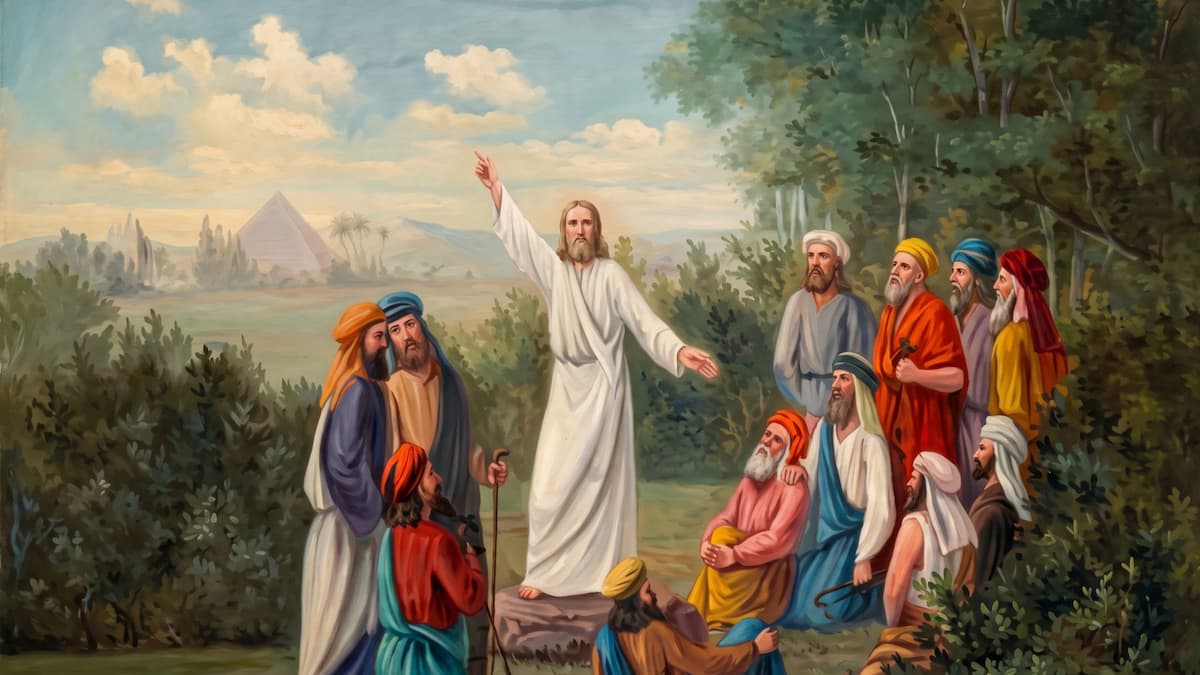
Latter-day Saint artwork of Jesus has evolved dramatically, shifting from early efforts to portray Jesus by artists like C. C. A. Christensen, to a reluctance to paint the Savior, and finally to a vibrant embrace of globally diverse portrayals. While mid-century artists like Arnold Friberg were instructed to obscure Christ, the late twentieth century sparked a realistic visual resurgence. Today, recognizable works like Del Parson’s Christ in a Red Robe share space with a new wave of culturally informed artwork depicting Jesus across various ethnicities and efforts to portray him in history-informed ways. In this interview, Jennifer Champoux explores the history, myths, and modern evolution behind these images.
Don’t miss new insights on topics such as C. C. A. Christensen and Who Was the Early Mormon Jesus? Sign up to get them straight to your inbox.


Early Reluctance and 19th-Century Latter-day Saint Art
When did Latter-day Saint artists first begin portraying Jesus Christ directly in their artwork?
The earliest Latter-day Saint meeting spaces, tabernacles, and temples were decorated primarily with painted portraits or sculptures of Church leaders. Then, in the 1880s, the Deseret Sunday School Union distributed Bible pictures—including New Testament scenes with Jesus—to Sunday Schools as teaching aids. Artists from outside the Church made these pictures, and American Protestants at the time used similar Bible charts. In the 1880s and 1890s, some New Testament scenes of Jesus were hung in Latter-day Saint temples. Utah artists like Danquart Weggeland and Christian Olsen painted these, but they were simply copies of European paintings.
Among the earliest original Latter-day Saint depictions of Jesus are:
- C. C. A. Christensen’s Baptism of Jesus, Crucifixion of Jesus, and Christ and His Disciples in the New World (all c. 1871-1875 from his Huntington Panorama)
- William Armitage’s The Glorious Appearing of Jesus to the Nephites (c. 1888)
- John Held Sr.’s Appearance of Christ to the Brother of Jared (c. 1888) (these last two appeared in George Reynolds’ The Story of the Book of Mormon in 1888).


What were the most common subjects and historical events that dominated Latter-day Saint paintings in the nineteenth century?
Early Latter-day Saint art generally fell into the categories of portraits, landscapes, or genre scenes.
Church leaders hired artists from both within and without the Church to paint their portraits. It was common for other members of the Church to have their portraits painted too.
Landscapes were popular in the nineteenth century, and Latter-day Saint landscape artists were influenced by the Hudson River School, the Barbizon School, the Düsseldorf School, the Rocky Mountain School, and Impressionism. In 1890, a few Latter-day Saint artists were even called as art missionaries to study painting in France and bring their improved skills back to paint landscape murals in temples.
Genre scenes showed Latter-day Saints in everyday life. Many genre scenes captured moments of pioneer journeys or daily life in Utah settlements.
When Jesus was portrayed in early Latter-day Saint art, what specific moments or themes were usually the focus?
In nineteenth-century Latter-day Saint art, Jesus was often portrayed as the good shepherd or in narrative New Testament scenes. In the narrative scenes, Jesus is usually among other Bible figures, speaking or doing something. This was comparable to how Jesus was generally portrayed in contemporary American and European art.

David O. McKay, Arnold Friberg, and Mainstream Reliance
Why were some prominent Latter-day Saint leaders opposed to painting images of Jesus, and how did artist Arnold Friberg creatively work around this institutional reluctance in his famous Book of Mormon paintings?
We do not know exactly why Latter-day Saint artists were discouraged from painting Jesus in the mid-twentieth century. Perhaps it was meant as an expression of reverence, born out of an iconoclastic Protestant heritage. Arnold Friberg recalled that while working on his series of Book of Mormon paintings in the 1950s, President David O. McKay told him not to paint the Savior.
This influenced the way Friberg painted the appearance of Jesus to the Brother of Jared and to the Nephites:
- In The Brother of Jared Sees the Finger of the Lord, the finger and body of Jesus are obscured by mist but indicated by the bright rays of light shining out of that mist.
- In Jesus Christ Appears to the Nephites, Friberg placed the resurrected Savior far away and high up in the sky, so he is symbolically present, but he does not have any defined features.
In both paintings, Friberg positions the viewer outside the scene, looking at the back of the main figures, who in turn look toward the center of the canvas at Jesus. The steep viewing angles add to the dramatic feeling, but both compositions have the effect of removing the viewer from an intimate communion with Christ and presenting instead a sort of stage tableau.
Given this hesitance, why did Latter-day Saints rely so heavily on mainstream European Christian art (like paintings by Carl Bloch and Heinrich Hofmann) for most of the twentieth century?
Church leaders had long recognized the value of religious art, including images of Jesus, to teach and inspire members (especially children). Although, for whatever reason, some mid-century leaders considered it inappropriate for members of the Church to paint Jesus, they still wanted to use images of Jesus. There was already a heritage in the Church of seeing pictures of Jesus by European artists. As Church leaders sought to present Latter-day Saints to the world, it made sense for them to use images already familiar to both members and non-members. This not only helped visualize the Latter-day Saints as fellow Christians, but it also allowed them to showcase their knowledge of fine art and culture. Using a large replica of Bertel Thorvaldsen’s already-famous Christus at the Mormon Pavilion of the 1964 World’s Fair, for example, signaled commonality in Western culture and Christian belief.

The Late 20th-Century Resurgence and Del Parson
When Latter-day Saints fully embraced painting images of Jesus again in the late twentieth century, what common themes and stylistic choices emerged?
Many images focused on images of Jesus during his mortal life, as described in the New Testament. These artworks tended toward a highly realistic, figurative style, and they sought an aura of historical authenticity by including certain types of costuming, architecture, and objects. Perhaps because of “The Living Christ” document released in 2000, many Latter-day Saint artworks of Jesus began to focus on the resurrected, living Savior. A theme emerged of non-narrative, portrait-like images of the living Christ. Often, these types of images showed him in nature in places like a field or on a hillside and used golden colors and a soft-focus effect.
Also, around this time, Church members from around the world were encouraged to submit artworks to the Church’s International Art Competition. Many of these pieces turned to familiar imagery of Jesus but situated him within their own landscapes or employed traditional artistic methods and materials from the culture.
Want More Scholar Interviews in Your Inbox?
Stay connected with fresh content and scholarly insights every week.
Del Parson’s “Christ in a Red Robe” is one of the most recognizable LDS paintings of Jesus. What urban legends surround the creation of this painting, and how has the artist himself responded to these stories?
One pervasive myth indicates that the prophet and First Presidency worked directly with Parson to portray Jesus’s appearance correctly. The implication was that the image is a true and accurate depiction of Jesus.
The myth gained strength with a story passed around about a child who saw the painting and said she recognized the man as the person who comforted her during a time of trauma. There was also a legend about the supposed symbolism of the light side of the face showing mercy and the side in shadow representing justice (I remember hearing this one in Sunday School from a newly returned missionary in 2000).
In interviews, Parson and his family have tried to debunk these legends and explain that during his work on this painting he only communicated with members of the Church’s Curriculum Graphics Department.
How has the Church’s policy of limiting approved foyer artwork to a select, standardized catalog shaped the everyday Latter-day Saint’s visual and spiritual experience with Jesus?
The May 2020 letter directed stake presidents to remove foyer artwork that did not depict the Savior. If an artwork needs to be replaced, the new piece must come from the approved list. So, there is still an allowance made for already-hanging images of Jesus not on the list. But over time, as foyer artwork is updated, it seems that the look of meetinghouse foyers will become more and more standardized.
In the six years since that letter, Church leaders added about 20 new pieces to the list and retired about 11 others. It appears to be a dynamic list that will continue to evolve to meet the needs of a global church. I’ve noticed that many artworks added to the list incorporate a greater diversity of figures with Jesus. There is some variety in how Jesus is portrayed too. And some of the pieces attempt to show a more historically accurate depiction of Jesus as a Jewish man in first century Roman Palestine.
Despite institutional limitations on foyer artwork of Jesus, members of the Church have access to a huge variety of depictions of the Savior in Church manuals and online resources, digital databases like The Book of Mormon Art Catalog, and artists’ online galleries.
The Future: Diversity and Global Portrayals
In recent years, how have Latter-day Saint artists experimented with more culturally and ethnically diverse portrayals of Jesus Christ?
Rose Datoc Dall and Esther Hi’ilani Candari are among Latter-day Saint artists using Middle Eastern models for their portrayals of Jesus in art. Their approach is motivated by a desire for greater historical accuracy and diversity.
Another recent trend among Latter-day Saint artists is to depict Jesus in a range of cultural or ethnic signifiers. In 2023, Julie Yuen Yim, a member of the Church in Hong Kong, painted Suffer Little Children to Come to Me. It is a narrative painting of the scene recorded in Matthew 19, in which Jesus gathers and blesses children. Jesus is a Chinese man, wearing a shanku (belted coat over trousers), with his hair pulled back and wrapped with a scarf in a customary manner. The Chinese children also wear traditional clothing. Within the history of images of Jesus, and especially within the context of Latter-day Saint artworks of Jesus, Yim’s painting is surprising. Although the historical Jesus was Jewish, he is also the universal Savior. Yim’s painting seeks to remind viewers of this truth.
Another example is Cristo con el niño by Mexican artist Israel Trejo. The composition focuses on Jesus bending to talk to a young Mexican child. The facial features of Jesus and the child are not clearly defined, but what stands out from the monochromatic scene is the colorful serape draped over the Savior’s shoulder. It is not so much the features of Jesus but his use of this traditional Mexican textile that positions him as a Savior who knows and loves this Mexican child perfectly.
To what extent have these non-traditional, global portrayals of Jesus Christ been accepted by the general membership and utilized by the Church institutionally?
In just the past few years, we’ve seen a greater variety of facial features in Church-supported images of Jesus. Instead of the tall, blue-eyed, muscular figure so familiar throughout much of the twentieth century (and inherited from centuries of Western European art), we see an increased demand by both members and Church leaders for images that portray Jesus in more historically informed ways.
A great example of this shift is a painting of Jesus by Walter Rane in the 2023 New Testament Come, Follow Me manual. In Light of the World the skin is olive, the nose more pronounced, the eyes brown and hooded, the hair falls more naturally. It is a significant move away from Rane’s 1997, The Resurrected Christ, in which Jesus has light skin, European features, blue eyes, and long brown hair softly parted in the middle.
There is also interest in more culturally informed depictions of the Savior. For instance, this past year the BYU College of Family, Home, and Social Sciences purchased and installed a painting of Jesus as a Black man by artist Eternity Stovall.
What do you hope to see in future Latter-day Saint artwork portraying Jesus Christ?
I hope to see more variety and diversity in art of Jesus. As Daniel Becerra wrote, there are so many attributes of Jesus that we want to study and understand, but it would be impossible to visualize them all in one painting. So, let’s have lots of paintings! Let’s have art of Jesus as creator, as good shepherd, as sacrificial lamb, as triumphant Savior, and many more.
Additionally, seeing visual testimonies by artists from around the world increases my own testimony of the Savior. Sometimes even the traditional mediums and materials of other cultures can communicate in different ways and help me realize additional truths. For instance, I am moved by Hopi artist Gary Evan Polacca’s depiction of Jesus and the brother of Jared on a clay pot. Using Hopi symbolism and abstract design, the pot helped me think more deeply about this scripture passage’s theme of moving by faith from darkness into divine light. A multiplicity of artistic perspectives helps me understand the Gospel in new ways and opens the possibility of receiving further insights and revelation.
Don’t Miss Our Latest Interviews!
Stay connected with fresh content and scholarly insights every week.
About the Scholar
Jennifer Champoux is an independent scholar and the creator and director of the Book of Mormon Art Catalog. She specializes in the visual culture of The Church of Jesus Christ of Latter-day Saints, tracing the historical and theological evolution of its religious imagery. As the co-author of Picturing Christ: Understanding Depictions of Jesus in History and Art and author of C. C. A. Christensen: A Mormon Visionary, her research frequently explores the intersection of scripture and visual representation. Champoux holds a master’s degree in art history from Boston University, has taught at institutions including Northeastern University, and previously served as the vice president of Mormon Scholars in the Humanities. Her extensive academic background provides a strong foundation for analyzing how Latter-day Saint art of Jesus has transformed from early institutional reluctance to the culturally diverse portrayals seen globally today.
Further Reading
Explore more From the Desk articles about Latter-day Saint artwork
- Repicturing the Restoration with Anthony Sweat Artwork
- Who Was C. C. A. Christensen?
- What Inspires Jorge Cocco Art?
- How Did Art Missionaries Prepare to Paint Temple Murals?
- What Role Does Vision Play in the Doctrine and Covenants?
Latter-day Saints Portrayals of Jesus Christ
Read what top scholars and publishers say about Latter-day Saint artwork portraying Jesus Christ:
- Picturing Christ: Understanding Depictions of Jesus in History and Art (Deseret Book)
- A Review: Picturing Christ: Understanding Depictions of Jesus in History and Art (Times and Seasons)
- The Book of Mormon Art Catalog
- Images of Christ in Latter-day Saint Visual Culture, 1900–1999 (BYU Studies)
- Tell Me the Stories of Jesus (International Art Competition)

