
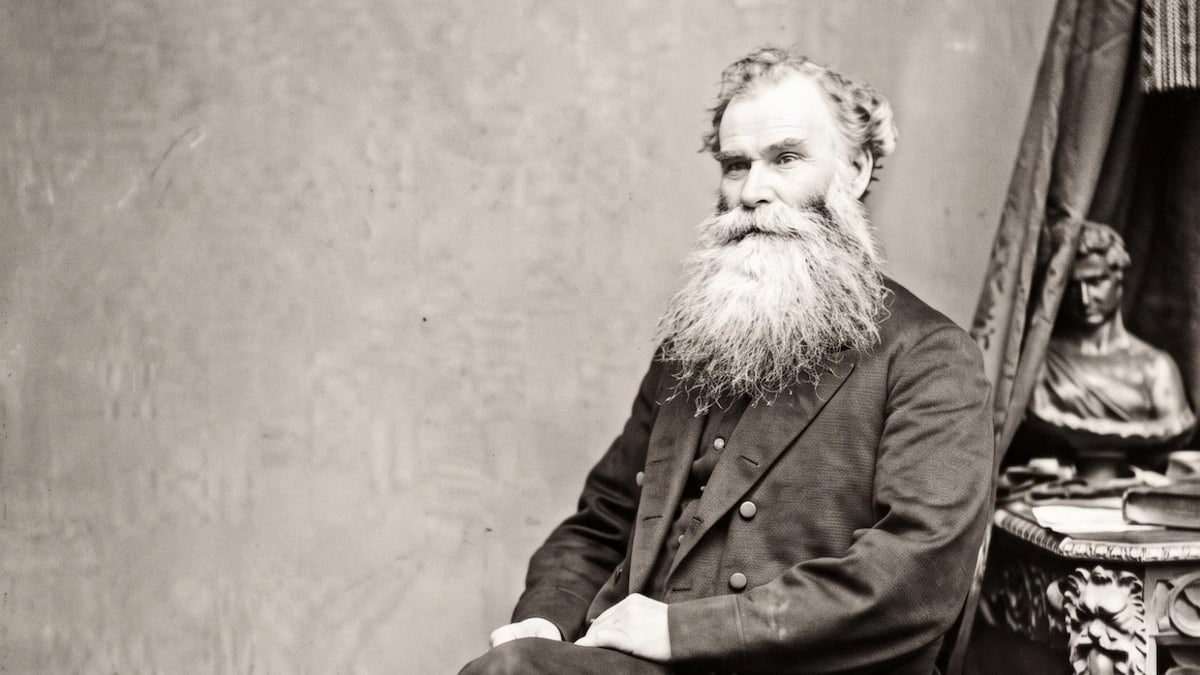
Orson Pratt was an original Latter-day Saint apostle and prolific theologian whose intellectual contributions helped shape the modern Church. Despite his foundational role in organizing the scriptures and coining the term “First Vision,” Pratt frequently clashed with leadership. He was briefly excommunicated over conflicts regarding plural marriage in Nauvoo, yet ironically became the practice’s foremost public defender. His fierce independence also sparked a decades-long conflict with Brigham Young over theology, race, slavery, and history. In this post, Chad L. Nielsen explores Pratt’s enduring legacy and complex role in early Latter-day Saint history.
Don’t miss new insights on topics such as Who Was Wilford Woodruff? and Brigham Young Quotes with Historical Citations. Sign up to get them straight to your inbox.
Table of Contents
- Conflicts with Other Church Leaders
- Family
- Theologian and Historian
- Scripture Revisions
- Death and Legacy
- Publications
- Further Reading
Orson Pratt’s Conflicts with Other Church Leaders
— Orson Pratt briefly left the church twice and engaged in a decades-long theological conflict with Brigham Young.
Did Orson Pratt leave the Church?
There were two main times that Orson Pratt disassociated with the Church for short periods. The first was during the 1837 “Great Apostasy” in Kirtland, Ohio, where many Latter-day Saints became estranged from Joseph Smith over the failure of the Kirtland Safety Society and the Fanny Alger scandal. Orson Pratt became critical of Joseph Smith because of financial and real estate dealings, and he and Lyman Johnson charged Smith before Bishop Newel K. Whitney with “lying and misrepresentation” and extortion. He also publicly criticized Smith, as did his brother, Parley P. Pratt. Both of the Pratt brothers were, however, reconciled to Joseph Smith and the Church later that same year.
The second time happened in 1842, during the Nauvoo era. While the Quorum of the Twelve served missions abroad in Great Britain and elsewhere, Joseph Smith began to expand his practice of plural marriage (polygamy). Smith was sealed to Apostle Orson Hyde’s wife, Marinda Nancy Johnson Hyde, while Hyde was on a mission and may have also approached Orson Pratt’s wife, Sarah Marinda Bates Pratt, while Pratt was in England. The details remain unclear, with two sides to the story being on the record. Sarah and John C. Bennett claimed that Smith had approached her to propose plural marriage and that she turned him down. In response, Smith launched a smear campaign, claiming that he had not approached Sarah and that, instead, she had an affair with John C. Bennett. Smith compiled a pamphlet of affidavits, certificates, and letters in an attempt to convince the public of his innocence. When Orson Pratt returned from his mission and found out about the accusations, he rebelled and was excommunicated. By early 1843, however, he had reconciled with Joseph Smith and the Quorum of the Twelve.


Why was Orson Pratt excommunicated?
As mentioned above, in 1842, Pratt encountered serious conflicts regarding Joseph Smith and the introduction of plural marriage—particularly concerning Smith’s approach to Pratt’s first wife, Sarah. Pratt was caught between believing his prophet had attempted to take his wife or that his wife had committed adultery while he was gone. He became deeply distressed and disappeared at one point, leading people to call a search out of concern that he was leaving to commit suicide. He withdrew from society, and when it became clear that he did not support Joseph Smith, he was excommunicated on August 20, 1842. Pratt reconciled with Smith within a few months, however, informing Smith of a plan by Bennett to kidnap him after Bennett had attempted to involve the disaffected Pratt. Soon afterwards, his excommunication was declared invalid on a technicality, and Pratt was reinstated in the Quorum of the Twelve.

Was Orson Pratt rebaptized?
Yes. He was rebaptized by Joseph Smith just months after his excommunication and returned to membership in the Quorum of the Twelve.
What was the conflict between Orson Pratt and Brigham Young?
Brigham Young and Orson Pratt frequently disagreed—often openly—over theological issues. Eugene England even called their series of conflicts the “thirty-years’ war.” The nature of God was of particular concern, with Pratt being critical of Brigham Young’s Adam-God doctrine. Young was likewise critical of Pratt’s attempts at reconciling monotheism with Mormonism’s teachings about humans becoming gods by claiming that the One God of the Bible was really a matrix of attributes shared by the many individuals who attained exaltation. Brigham Young felt that God increased eternally in both understanding and power, while Orson contradicted that idea, stating that God had progressed to the limit of knowledge and wisdom. Other conflicts arose over the nature of the Holy Ghost and other ideas.
Another area of conflict was around Brigham Young’s justification of the priesthood and temple ban against individuals with Black African ancestry through the curse of Cain ideology. While Pratt ultimately accepted the ban and offered some rationales for it himself, he argued that the curse of Cain was invalid and that people of African descent were “innocent,” while Brigham Young defined them as “cursed.” Pratt also did not want slavery legalized in any form in Utah Territory and argued in favor of extending the vote to Black men, in opposition to Young, who argued for a form of “servitude” that granted enslaved people some rights—but that freed no one currently enslaved.
Young and Pratt clashed over other issues as well. This included the reorganization of the First Presidency in 1847 and the publication of Lucy Mack Smith’s history of Joseph Smith in 1853. As a result, Brigham Young denounced some of Orson’s ideas from the pulpit, contradicting him in the October 1855 conference, and attacking his works off and on over the years, and allowing other general authorities, such as Jedidiah Grant, to do the same. Young organized a disciplinary trial in 1860, and while Pratt defended himself until midnight, he did not win out in the end. Young even issued a First Presidency proclamation, denouncing some of Pratt’s works and laying down a rule:
No member of the Church has the right to publish any doctrines of the Church of Jesus Christ of Latter-day Saints, without first submitting them for examination and approval to the First Presidency and the Twelve. There is but one man upon the earth, at one time, who holds the keys to receive commandments and revelations for the Church, and who has the authority to write doctrines by way of commandment unto the Church. And any man who so far forgets the order instituted by the Lord as to write and publish what may be termed new doctrines, without consulting with the First Presidency of the Church respecting them, places himself in a false position, and exposes himself to the power of darkness by violating his Priesthood.
1865 Proclamation of the First Presidency and Quorum of the Twelve, Millennial Star Vol. 27 (Oct. 21, 1865), 663.
The tension created through these repeated clashes ultimately led Brigham Young to alter Pratt’s seniority in the Quorum of the Twelve Apostles, arguing that Pratt’s 1842 excommunication had voided his original place in the hierarchy and that seniority in the Quorum of the Twelve was calculated based on continuous service in the quorum, which meant that John Taylor and Wilford Woodruff had seniority over Orson Hyde and Orson Pratt.
It is of interest to note that some of the doctrines Brigham fought Orson Pratt over have since become the official doctrines of the Church. The Lucy Mack Smith history is quoted in Church publications and official histories. His views on Adam being created from the dust of the earth and on God having reached the limits of knowledge and wisdom have support from recent Church leaders. At the same time, it must be noted that some of his ideas, such as the nature of the Holy Ghost, intelligences, and worship of the attributes of God rather than a being, are not accepted as doctrines of the Church.
Further Reading on Orson Pratt’s Conflicts
- Did Parley P. Pratt Leave the Church?
- Who Was Brigham Young?
- What Did Orson Pratt Say About Race and the Priesthood?
- “The Orson Pratt-Brigham Young Controversies: Conflict within the Quorums, 1853 to 1868,” by Gary James Bergera, Dialogue: A Journal of Mormon Thought, vol. 13, No. 2 (Summer, 1980), pp. 7-49.
Want More Scholar Interviews in Your Inbox?
Stay connected with fresh content and scholarly insights every week.
Orson Pratt Family
— Elder Pratt married ten women and fathered 45 children, but also pioneered early Latter-day Saint genealogical research.
How many wives and children did Orson Pratt have?
Orson Pratt married 10 women and fathered 45 children with eight of them.
Orson Pratt’s wives:
- Sarah Marinda Bates Pratt
- Charlatte Bishop
- Adelia Ann Bishop
- Mary Ann Merrill
- Louisa Chandler
- Marian Ross
- Sarah Louisa Lewis
- Juliaet Ann Phelps
- Eliza Crooks
- Margaret Graham
Who was Orson Pratt’s first wife?
Sarah Marinda Bates Pratt was Orson Pratt’s first wife. She is notable due to her central role in his temporary departure from the church during the 1840s and her eventual outspoken opposition to polygamy. She spoke out against plural marriage, even if she tolerated Orson Pratt’s practice of it for a time, and was strongly supportive of the Anti-Polygamy Society in Salt Lake City. Sarah was excommunicated from the Church on October 4, 1874. She became irrevocably estranged from Orson in 1868, when Orson married sixteen-year-old Margaret Graham, with Sarah citing his “obsession with marrying younger women” as the reason for effectively ending their marriage.
Who Are Some Famous Descendants of Orson Pratt?
- George W. Romney
- Mitt Romney
- Jon Huntsman
- Orson Pratt Huish
- Dale L. Morgan
Orson Pratt’s Genealogy Research
While he was in Washington, D.C., in the 1850’s, Pratt became interested in his genealogy. He wrote to all the relatives he knew of for information on his ancestors, and found a man by the name of Rev. Frederick W. Chapman, who had information on his family. Pratt was eager to learn what Chapman had found and also wanted to help in research, returning to Britain to scour the parish records there. They collaborated on a definitive book on the Pratt family in America.
Pratt was, along with Wilford Woodruff, one of the first Latter-day Saints to attempt to systematically perform baptisms for the dead for his ancestors and relatives.
Pratt’s efforts in genealogy helped to salvage his relationship with his brother Parley. They had a major falling out for several years, but when he began working on family history research, Orson wrote to his brother, reminded him of their shared family history, and asked for forgiveness, and they were able to reconcile with each other.
Further Reading about Orson Pratt’s Family:
- Redeeming the Dead: Themes in the Doctrine and Covenants
- Sarah M. Pratt: The Shaping of an Apostate
- Orson Pratt Family
Orson Pratt as Theologian and Historian
— As the Church Historian and foremost intellectual, Pratt defended plural marriage and coined the “First Vision.”
Mormon Polygamy
Did Orson Pratt announce polygamy?
Yes. In a somewhat ironic twist, given his experiences in Nauvoo, when the First Presidency decided to go public about polygamy, Pratt was the man chosen for the job. In August 1852, Pratt spoke in general conference on the topic of “marriage.” In this speech, he read the document that became Doctrine and Covenants 132, outlined the Biblical practice of polygamy, and offered several central reasons for Latter-day Saints to practice polygamy.

Almost immediately after this conference, Pratt went to Washington, D.C., to preside over the Church in the eastern United States and to write and publish in defense of the Church. Soon after arriving, he started up a monthly periodical entitled The Seer and published a series of articles on polygamy as well as the preexistence, methodically vindicating and outlining both ideas. Later on, he would defend polygamy in a debate with US President Ulysses S. Grant’s chaplain, Rev. Dr. John P. Newman.
What Did Orson Pratt Teach About Polygamy?
William V. Smith noted, “Doctrinal expositors like Orson Pratt mapped out the nature of the exalted afterlife, pointing out that even in heaven, there had to be a gestation time for these spirit children.” He added,
Pratt saw polygamy in heaven as a solution to a real problem. First, the glory of divine beings was the work of tutoring spirits to be like them and if spirits, as Pratt put it, were to be produced in the wombs of exalted females, there had to be a gestation time (Pratt had an Aristotelian dislike of the idea of no “cause” for spirits).
How to overcome this? You needed many, perhaps millions, of wives for each exalted man. Such was the metaphysics of polygamy and the reasons why it had to not only be on earth (bringing more divinely sired spirits to earth to become Latter-day Saints as scions of faithful patriarchs), but in heaven for the same work (some of this still echoes in declarations like “you are the *literal* children of God”).
The King Follett Sermon: A Biography
This meant that Pratt helped develop a different cosmology than the one Joseph Smith outlined in the King Follett Sermon, focusing on what Jonathan Stapley has called “viviparous spirit birth” instead of uncreated intelligences.
It was also Pratt who published an account of the plural marriage sealing ceremony in The Seer.
History and the First Vision
Orson Pratt was deeply interested in the Church’s history, especially episodes like the First Vision. He was the first person to publish an account of the First Vision in his 1840 pamphlet, A[n] Interesting Account of Several Remarkable Visions. It was also Pratt who coined the term “first vision” in 1849 to describe the event, and he served as the foremost spokesperson for the First Vision in the Church after Joseph Smith’s death. As a result, Dr. Keith J. Wilson observed that Pratt has been called the “defender of the First Vision” and that “we might aptly add, ‘promoter, advocate, and testator.’”
Orson Pratt was assigned to serve as Church Historian and Recorder for The Church of Jesus Christ of Latter-day Saints from 1874 until he died in 1881. In this position, he sought to put together an orderly history of the Church and to record every day’s events in a “journal history” of the Church. As part of his initiative, he traveled with Joseph F. Smith in 1878 to Missouri, Illinois, Ohio, and New York to collect affidavits and other records related to the history of the Church. They met with David Whitmer, members of the Reorganized Church, and visited the Hill Cumorah along the way.
Preaching
Orson Pratt was labeled by William W. Phelps as “The Gauge of Philosophy,” and he was often looked to as the doctrinal authority of the Church. Yet, his interest in philosophy and science led him into speculation about ideas that were not and are not considered doctrine. As Terryl Givens observed,
The Latter-day Saint tradition has not made much room for theology or theological speculation in its two centuries. The early period saw ambitious forays, most notably with the apostle Orson Pratt, but even his intellectually free-wheeling was recurrently curbed by Brigham Young.
The Biography of Eugene England
(For example, his idea that the Holy Ghost was an inexhaustible substance was part of the development of the doctrine of the Holy Ghost in the Church that was later rejected.)
Still, Pratt was often considered the authority on Church doctrine and influenced the next generation of Latter-day Saint leaders and theologians, including Joseph F. Smith and B. H. Roberts.
Pratt was one of the most notable interpreters of Joseph Smith’s revelations, sermons, and other writings. For example, he worked to explain the 1832 Vision (Doctrine and Covenants 76) to early Latter-day Saints, and he advocated for Joseph Smith’s Civil War revelation (now Doctrine and Covenants 87), frequently using it as an example of Joseph Smith’s abilities as a prophet.
Pratt frequently preached in Salt Lake City, and many of his sermons were recorded by trained stenographers, like George D. Watt, and published in the Journal of Discourses or other Church publications. He liked to speak on a variety of topics such as:
- The seriousness of leaving the church
- The nature of God
- The nature of humans, body and spirit, resurrected bodies, and exaltation
- The past persecutions of the Latter-day Saints and other topics from Church history.
Historian John Turner noted that Pratt has a “creative theological mind” and “contributed to the gradual emergence of new ideas,” along with figures like Parley Pratt, Eliza R. Snow, and William W. Phelps.
Further Reading on Orson Pratt’s Theology
- The First Vision
- The King Follett Sermon: A Biography
- The Development of the Latter-day Saint Doctrine of the Holy Ghost
- What Orson Pratt Sermons Are in George D. Watt’s 1851 Journal?
Scripture Revisions
— During the 1870s, Pratt extensively revised and formatted the scriptures into the foundational editions used today.
Elder Pratt was not only considered the doctrinal authority of his day, but he was also considered the primary expert on the scriptures of the Church. Thus, he was given the task of revising the scriptures during the 1870’s. His efforts changed the shape of Latter-day Saint scriptures, and modern editions published by the Church are based on his work:
- The Book of Mormon: Pratt added cross-references, adjusted versification and Book of Mormon chapter divisions, and corrected misspelled words and some grammatical errors.
- The Doctrine and Covenants: Pratt rearranged the Doctrine and Covenants to be closer to chronological order and added twenty-five sections. Many of these new sections were from the history of the Church, including the sections from Joseph Smith in Nauvoo. [That one guy] has noted that many of these additions undergirded temple doctrine in the Church during an era of expanding temple consciousness. Because of this, Steven Harper noted that “Orson Pratt’s painstaking and inspired work on these editions is monumental. His editorial fingerprints are still found in the most recent edition of the Doctrine and Covenants.”
- Pearl of Great Price: Before Orson Pratt’s edition, the Pearl of Great Price circulated as a missionary pamphlet put together by Elder Franklin D. Richards in the 1850’s, but was not yet considered canonical scripture. Elder Pratt added sections of the Book of Moses to this compilation and revised it. It was accepted as a standard work of the Church in October of 1880.
In addition to his revisions of the scriptures for the general Church, Orson Pratt and his family worked to create editions of the scriptures in the Deseret Alphabet, with the Book of Mormon being the only volume that was published.
Further Reading on Orson Pratt’s Scripture Revisions
- A Brief History of the Doctrine and Covenants
- Orson Pratt and the Expansion of the Doctrine and Covenants
- How Many Chapters Are in the Book of Mormon?
Orson Pratt’s Death and Legacy
— Pratt died in 1881, leaving behind a monumental legacy as a missionary, pioneer, and doctrinal thinker.
How did Orson Pratt Die?
Orson died from complications due to diabetes in October of 1881, at age seventy. His final words became his epitaph: “My body sleeps for a moment, but my testimony shall endure forever.” He left an incredible legacy behind him, both in family and in influence on the Church.
Where is Orson Pratt Buried?
Orson Pratt is buried in the Salt Lake City Cemetery.
What is Orson Pratt’s Legacy?
In addition to his family, Orson Pratt did much to build up the Church. He was one of the most successful missionaries for the Church; was one of the earliest theologians to give shape and order to the teachings and revelations of Joseph Smith through his own teachings and his editions of the scriptures, influencing Latter-day Saint doctrine to this day; assisted in the pioneering of Utah; and served for many years as the leading spokesman for the Church.

Publications
Orson Pratt was a prolific and influential writer in the Church of Jesus Christ of Latter-day Saints. Some of his most notable publications include:
- A[n] Interesting Account of Several Remarkable Visions, and of the Late Discovery of Ancient American Records (1840)
- Divine Authority, or the Question, Was Joseph Smith Sent of God? (1848)
- The Kingdom of God (1848–1849)
- Absurdities of Immaterialism, or, A Reply to T.W.P. Taylder’s Tract (1849)
- Divine Authenticity of the Book of Mormon (1850–1851)
- The Great First Cause, or the Self-Moving Forces of the Universe (1851)
- The Seer (1853–1854)
- Key to the Universe, or a New Theory of Its Mechanism (1879)
Don’t Miss Our Latest Interviews!
Be part of a growing community exploring history, religion, and scholarship.
Further Reading
Biographies of Orson Pratt
- The Life and Thought of Orson Pratt, by Breck England (University of Utah Press, 1985)
- The Orson Pratt Journals, compiled by Elden J. Watson (Deseret Book, 1975)
Notable Collections of Orson Pratt’s Writings and Preaching
- The Essential Orson Pratt, by David J. Whittaker (Signature Books, 1991)
- Masterful Discourses and Writings of Orson Pratt (Compiled by N.B. Lundwall, 1946)
Official Church Resources
- Orson Pratt Biography (Joseph Smith Papers)
- Orson Pratt (Doctrine and Covenants Historical Resources)
- Orson Pratt (Prophets and Apostles of the Last Dispensation)
- Orson Pratt’s Call to Serve (Revelations in Context)

