
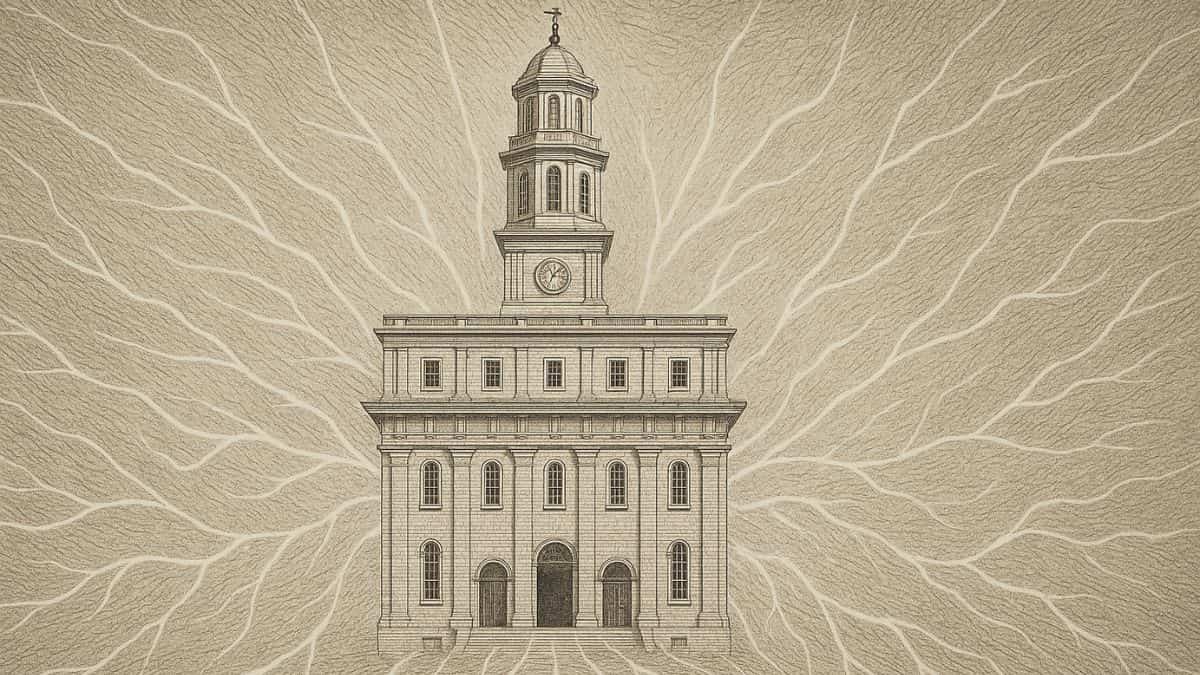
The 19th-century law of adoption was a short-lived Latter-day Saint temple ritual in which church members were sealed as children to people other than their parents. Between 1846 and 1894, thousands of men and women were ceremonially sealed—not just to biological parents, but often to prominent leaders such as Brigham Young and Heber C. Kimball. President Wilford Woodruff ended the practice in 1894, counseling members to be sealed to their biological parents. In this interview, historian Jonathan Stapley explains what the law of adoption was, why it mattered, and how its legacy continues to influence modern sealing practices today.
Don’t miss new insights on topics such as the Law of Consecration and the St. George Temple. Sign up to get them straight to your inbox.
Defining the 19th-Century Law of Adoption
How did the law of adoption differ from the sealings practiced today?
The 19th-century “law of adoption” referred to sealing relationships between adults, rather than the parent-child sealings common today. What some called “the law of adoption” was more simply just “adoption,” or what I have termed “adoptive sealings.”
After Joseph Smith’s death, the Quorum of the Twelve completed the Nauvoo Temple and worked to administer the temple ceremonies to thousands. Their efforts centered largely on the endowment ceremony and marriage sealings, not on child-to-parent connections.
In fact, very few child-to-parent sealings were performed at all—and of those, a little more than half joined people who were not biologically related. No child-to-parent sealings were ever performed outside of temples, so the practice did not resume until the dedication of the St. George Temple in 1877.
Why did early Saints see adoption sealings to priesthood leaders as essential to exaltation?
Early Latter-day Saints believed you should only be sealed to parents who had accepted the gospel in mortality. For those without that option, the solution was to be sealed to other church members as adoptive parents.
This practice supported the efforts of early Latter-day Saints to construct an interconnected network of sealings, with church leaders frequently—though not exclusively—serving as adoptive parents.
Underlying this was a communal vision of exaltation. While modern Latter-day Saints may sometimes think of exaltation in individual terms, there is a long tradition of viewing heaven as a collective reality. To be complete, it required being connected not only to one’s ancestors but also to each other.
Did early church leaders believe that plural marriage was essential for exaltation?
Plural marriage was a complex issue, and church leaders expressed shifting views over time regarding its necessity for exaltation. During periods of intense religious focus or outside criticism, leaders often “retrench”—a term sociologist Armand Mauss used to describe patterns that supported the church’s historical persistence. In such moments, they sometimes made strong claims that plural marriage was essential for exaltation.
At other times, however, the same leaders suggested that it was not strictly necessary—or at least complicated the ways in which it might be.
Because of this variation, it is important not to focus on a single statement from one leader. A clearer picture emerges when integrating as many records as possible across different contexts to better illuminate the beliefs of early Saints and their leaders.
Want More Scholar Interviews in Your Inbox?
Stay connected with fresh content and scholarly insights every week.
The End of Temple Adoption
Why did Wilford Woodruff end adoption sealings?
By the 1890s, adoption had become a source of confusion for both church members and leaders. Between 1846 and 1877, no child-to-parent sealings were performed, and when temples came online again, many Saints struggled with how to understand and practice adoption. Leaders like Wilford Woodruff himself explained that they had learned the practice directly from Brigham Young, yet questions continued to grow.
Some leaders began seeking to cancel their adoption sealings so they could instead be sealed to their biological parents.
Soon after the dedication of the Salt Lake Temple, Woodruff announced to the First Presidency and the Twelve that he had received a revelation ending adoption sealings.
He then presented the revelation publicly in General Conference, formally shifting temple work to sealing families along biological lines.
What happened to adoption sealings performed before 1894?
The First Presidency clearly wanted to avoid canceling sealings outright. While they did allow cancellations upon request, they generally preferred to have people perform new sealings and let the earlier temple work stand.
This approach marked an important development in what has become a common Latter-day Saint understanding: that proxy ordinances are carried out imperfectly, and that God, together with the agency of deceased individuals, will ultimately be the final arbiter.
How did Wilford Woodruff’s 1894 revelation demonstrate the principle of ongoing revelation?
When President Wilford Woodruff announced the revelation in General Conference, he emphasized that the Saints should expect continuing guidance from heaven: “We have not got through revelation,” he declared.
He then situated the change in a broader prophetic trajectory:
President Young, who followed President Joseph Smith, led us here. He organized these Temples and carried out the purposes of his calling and office. He laid the foundation of this great Temple on this block, as well as others in the mountains of Israel. What for? That we might carry out these principles of redemption for the dead. He accomplished all that God required at his hands. But he did not receive all the revelations that belong to this work; neither did President Taylor, nor has Wilford Woodruff. There will be no end to this work until it is perfected.
Wilford Woodruff
I think it is fair to say that church leaders today are still engaged in that process.
Continuing Influence on Modern Sealing Practices
How did Joseph Smith’s temple liturgy create a cosmological priesthood, and how does that shape sealing today?
This is a major theme of both of my books, The Power of Godliness and Holiness to the Lord. Most Latter-day Saints are familiar with Joseph Smith’s teachings that hell was to be isolated, separate, and alone. In his April 7, 1844 General Conference sermon, he even quipped: “I have no fear of hell fire, that don’t exhist.”
By contrast, Joseph revealed a cosmology in which heaven was expansive and communal. He envisioned heaven as the people sealed together—what he recognized in John of Patmos’s vision of heaven as the great concourse of kings and priests surrounding the throne of God from every nation, kindred, and people.
It echoes Joseph Smith’s vision of heaven as a vast, interconnected order.
Importantly, the Prophet expanded that vision to include women—queens and priestesses—that together formed the sealed network of heaven.
The transmission of this cosmology through generations is complex, but it continues to shape how many Latter-day Saints today understand sealing. For many, sealed relationships across time constitute an eternal kinship, echoing Joseph Smith’s vision of heaven as a vast, interconnected order.
How does 19th-century sealing cosmology influence modern policies on widows, widowers, and divorce?
In the nineteenth—and even into the early twentieth—century, women were regularly sealed to their sequential husbands. Today, that pattern persists in proxy ordinances: deceased women are sealed to all of their previous husbands.
However, from the early twentieth century to the present, church leaders have maintained a different policy for the living. Men who are widowed or divorced may be sealed to sequential wives, but living women cannot be sealed to more than one husband without first canceling the prior sealing.
This asymmetry reflects how nineteenth-century sealing cosmology, with its expansive network of relationships, has been reshaped into the policies governing modern temple practice.
How have modern sealing policies shaped member anxieties about eternal polygamy?
Many members—particularly, though not exclusively, women—have had to work through the implications of sealing policies. In cases of death or divorce, members who remarry must navigate how those policies apply.
Because living men can readily be sealed to more than one spouse, while living women cannot, some worry that the rules reflect a cosmological reality. This possibility raises anxieties that “eternal polygamy” is embedded in heaven itself.
For many good, practicing church members, that prospect is deeply disconcerting.
Who were the most common adoptive fathers, and why were leaders like Joseph Smith and Brigham Young central?
It is notable that 211 adoptions were performed in the Nauvoo Temple. Brigham Young was the adoptive father of 66 of them, and Joseph Smith was the adoptive father of only one. However, after adoption was reintroduced with the dedication of the St. George Temple, Joseph Smith quickly became perhaps the most common adoptive father.
A church leader seemed like a logical choice.
Adoption served to tie up loose ends in the sealing network. In Nauvoo, the focus was largely on living ceremonies. In Utah, the emphasis shifted, and proxy work became an important concern.
Many people chose church leaders as adoptive parents because they seemed like the best bet. And Joseph Smith—being martyred—was perhaps the safest bet of all. If you wanted to be sealed to someone who was surely part of the network of heaven, then a church leader seemed like a logical choice.
How does the law of adoption shed light on the Latter-day Saint view of heaven?
Adoption, along with the other complex sealing arrangements of the nineteenth century, highlights the degree to which heaven not only incorporated immediate relationships but also transcended them.
If heaven were to be realized on earth, it had to accommodate all of the varied realities that constituted the Saints’ relationships.
Human Experiences of Adoption Sealings
What is an example of the confusion and destabilization caused by nineteenth-century adoption sealings?
The current practice of sealing all generations together resonates among believers in important ways. By contrast, nineteenth-century policies barring sealings between people who weren’t church members could stifle temple work generally and raise troubling questions about the eternal fate of loved ones within the plan of salvation.
Why is Jane Manning James’s account of Emma Smith’s adoption invitation so puzzling?
Jane Manning James is one of the great heroes of the Restoration. And she lived with the brunt of Brigham Young’s temple and priesthood restrictions. In a reminiscence, near the end of her life, she described how, when she lived with Joseph and Emma in Nauvoo, Emma Smith asked her to be adopted into their family.
In some ways, this was a puzzling memory, as adoptive sealings hadn’t been introduced yet. There are several possibilities, each with interesting ramifications.
As I write in Holiness to the Lord, Emma had black family members. Her aunt married a black man. While it is impossible to know exactly what happened, it is possible that Emma was inviting Jane to join the Smith family as a child or as a wife.
Lessons from the Law of Adoption
What are popular misconceptions about adoption sealings?
Two persistent errors still appear today, even in scholarly literature. The first is the claim that only men were adopted. This is just plain false. Men and women together functioned as adoptive parents, and both men and women were adopted as children. Everyone needed to be sealed to parents. For example, 47% of the adoptions performed in the Nauvoo Temple were for women.
A second significant error is the assertion that adoptions were performed outside of temples between 1846 and 1877. There is absolutely no evidence to support this, and a preponderance of evidence indicates that none were performed.
What lessons can Latter-day Saints draw from this history?
An important lesson from this history is that adoption sealings were far more expansive and complex than many assume, and understanding them can help modern Saints appreciate the breadth of early church leaders’ cosmological vision of heaven as a sealed and interconnected community.
Don’t Miss Our Latest Interviews!
Be the first to read our latest in-depth articles.
About the Scholar
Jonathan A. Stapley is an independent historian and scientist who has written extensively on the law of adoption in early Mormonism. His research focuses on Latter-day Saint temple liturgy, ritual, and cosmology, with adoptive sealing practices as a central theme. He is the author of The Power of Godliness: Mormon Liturgy and Cosmology (Oxford University Press, 2018) and the landmark article “Adoptive Sealing Ritual in Mormonism” in the Journal of Mormon History. His work has received awards from the Mormon History Association and is widely recognized for its careful archival research and scholarly contribution. Stapley’s insights into the law of adoption shed light on how nineteenth-century sealing practices shaped Mormon identity and continue to influence modern temple understandings.
Further Reading
- How Has Temple Worship Evolved Since Joseph Smith’s Time?
- What Happened When Wilford Woodruff Stopped Adoption Sealings?
- What Is the Law of the Gospel?
- How Did Freemasonry Influence the Endowment?
- What Was Wilford Woodruff’s Vision of the Founding Fathers?
Law of Adoption Sealings
- Holiness to the Lord: Latter-day Saint Temple Worship (Oxford University Press)
- The Law of Adoption: One Phase of the Development of the Mormon Concept of Salvation, 1830-1900 (BYU Studies)
- The Historiography of Adoptive Sealing Practice (Juvenile Instruction)
- The Law of Adoption (Wilford Woodruff, George Q. Cannon) (Keepaptichinin)
- The Sealing Change and Woodruff ‘Revelation’ Most Latter-day Saints Know Little About (Mormon Land)

