
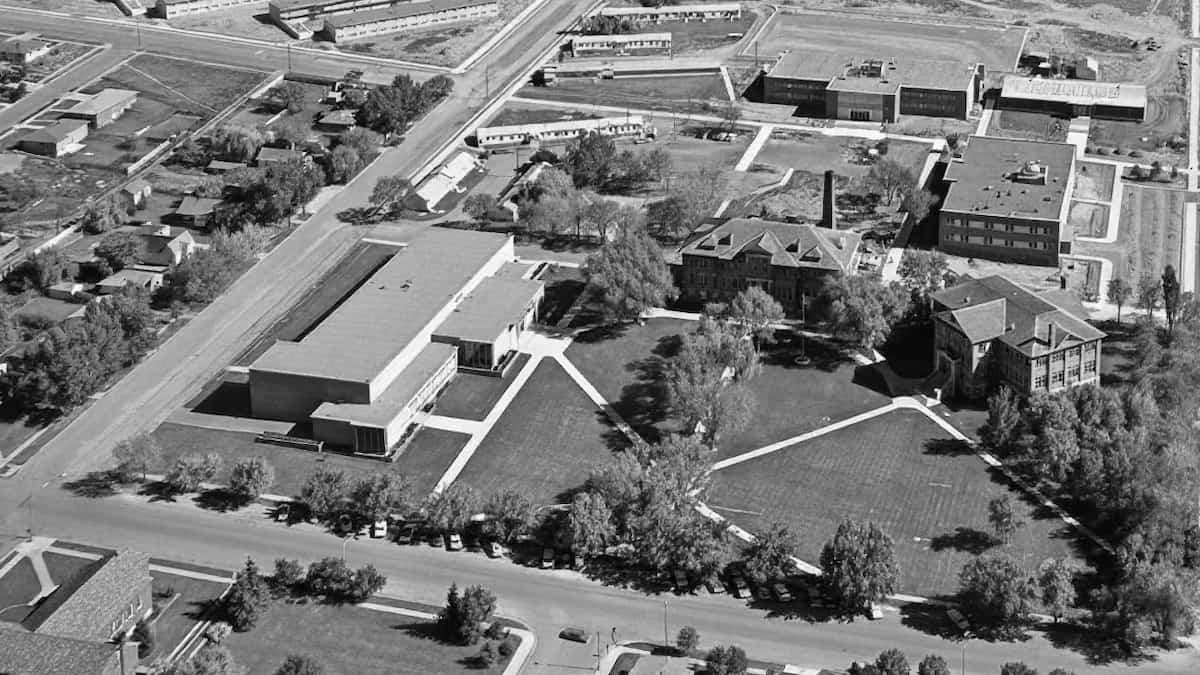
Former BYU President Ernest L. Wilkinson envisioned a network of LDS junior colleges across the West to protect students from secularism while preserving Brigham Young University’s tight-knit community. During the 1950s and 1960s, Wilkinson purchased several properties across the western United States, tried reclaiming state-owned Utah campuses, and spent six years fighting to relocate Ricks College to Idaho Falls. However, rising churchwide budgetary demands, local pushback, and opposition from leaders like Boyd K. Packer ultimately defeated the plan. In this interview, historian Gary J. Bergera explores the rise and fall of Wilkinson’s unfulfilled educational vision.
Don’t miss new insights on topics such as Ernest Wilkinson and The Biography of Eugene England. Sign up to get them straight to your inbox.


Junior Colleges
— Ernest Wilkinson envisioned a vast network of LDS junior colleges across the West to feed Brigham Young University.
What was Ernest L. Wilkinson’s master plan for creating a large, interconnected LDS Junior College system across the American West?
Wilkinson believed that the best way to manage the future of LDS higher education was to establish LDS-owned junior colleges across the United States in areas of greatest—actual and projected—LDS population.
He dreamed of an internationally recognized LDS university—christened the University of Deseret—of some 12,000 upper-level undergraduates headquartered at BYU, continually fed by an expanding network of two-year junior colleges, where freshmen and sophomores would be taught the truth untainted by godless secularism.


Throughout the 1950s and into the 1960s, Wilkinson enjoyed the support of Church President David O. McKay and the Church’s Board of Trustees for his ambitious idea, and arranged for the purchase/acquisition of the following nine tracts of land for junior colleges.


How did Wilkinson envision junior colleges in states such as California, Arizona, and Oregon to function as a funnel to preserve BYU’s culture and capacity?
Wilkinson liked the idea of BYU as a smaller institution; he worried that if BYU got too big, it would lose the tight-knit social community—“overall school spirit and overall friendliness”—he believed most benefited students (Educating Zion: The Diaries of BYU President Ernest L. Wilkinson, p. viii). Thus, a network of junior colleges could best help BYU to superintend the growth and size of its own student body, thereby fostering a better overall college experience for students.
What resistance to the idea did Wilkinson meet, and why did the LDS Church ultimately abandon plans for an expansive educational network?
The growth of the LDS Church generally, and especially the influx into higher education of college-age students following the Korean War, prompted Wilkinson and the Church to take a renewed look at the place of BYU in its educational system. Wilkinson was convinced that his junior college initiative was a big part of the answer.
As the Church confronted increased spending needs worldwide, however, a growing number of general authorities became concerned about financing Wilkinson’s plans at the expense of other areas of growth and need. Boyd K. Packer, especially, following his appointment in 1961 as an assistant to the Twelve, focused on Wilkinson’s spending as it impacted the church’s seminary and Institute program, with which Packer had been intimately involved. Packer was convinced that Wilkinson prioritized BYU over the rest of the Church Educational System (see, for example, Educating Zion, pp. 394-97).
Gradually, during the early to mid-1960s, it became clear to Wilkinson that he could not compete successfully with the Church’s general budgetary needs. The Church eventually decided to confine its focus on higher education to BYU, followed by Ricks, the Church College of Hawaii, and the Institutes. By the mid-1970s, most of the junior college properties had been sold.
How did the declining health and advancing age of President David O. McKay impact Wilkinson’s ability to push his junior college agenda?
David O. McKay was Wilkinson’s advocate. With his one vote, McKay could—and sometimes did—overrule an otherwise united quorum and board. As McKay aged, and especially as he began to decline mentally, other general authorities started to assert their objections to Wilkinson’s proposals more forcefully. (Plus, McKay never had much appetite for conflict.) The junior college program was increasingly branded as too expensive and as diverting scarce monies away from seminaries and Institutes. With opposition mounting, and lacking McKay’s once-vigorous support, Wilkinson backed down.
Why did the state of Utah try to return Weber College, Snow College, and Dixie College to the Church? How and why was the return of these colleges to the Church blocked? Did any of this factor into Wilkinson’s plans?
During the 1920s, Church President Heber J. Grant commented during a meeting of the Church Board of Education, “Nothing has worried me more since I became president than the expansion of the appropriation for the church school system.” With demands increasing and resources dwindling, Church leaders considered plans to “withdraw from the field of academic instruction altogether and center educational efforts in the promotion of a strictly religious education program.”
In 1926, the board of education agreed to sell its junior colleges and to retain BYU, where emphasis could be placed on “preparation of … teachers of religious subjects.” Brigham Young College in Logan, Utah, closed immediately. A little later, the Church transferred Snow College, Weber College, and Dixie College to the state of Utah, and Gila Academy in Thatcher to Arizona. Idaho declined to take Ricks, and the LDS Business College in Salt Lake City remained in Church ownership. (The quoted material is from Kenneth Bell’s 1969 BYU master’s thesis, “Adam Samuel Bennion: Superintendent of LDS Education, 1919-28.”)
Wilkinson became the administrator/chancellor of all Church schools in 1953 (two years after he was appointed BYU president) and began to formulate plans to implement his vision of junior colleges feeding juniors and seniors to BYU. The following year, at Wilkinson’s urging, Utah’s governor agreed to ask the state legislature to return Snow, Weber, and Dixie to the Church. But a referendum forced a popular vote on the issue. Concerned with the hostility engendered by the referendum, President McKay decided not to publicly endorse the proposed transfer. After a heated campaign, Utahns defeated the transfer bill. Frustrated, Wilkinson continued to champion his feeder junior colleges and lobbied for the relocation of Ricks from Rexburg to Idaho Falls.
Moving Ricks College to Idaho Falls
— Ernest Wilkinson spent six years trying to relocate Ricks College to Idaho Falls before Church leadership overruled him.
What specific logistical, economic, and enrollment factors made Idaho Falls such an appealing alternative to Rexburg for the future of Ricks College?
Put bluntly, Wilkinson believed that Idaho Falls’s future was much brighter than Rexburg’s. He contended that, among other reasons to transfer Ricks:
- The number of LDS Church members in Idaho Falls will be five times greater than in Rexburg by the year 2000
- Idaho Falls will develop “into a stronghold of LDS cultural agencies which would enrich and fortify the college’s program and purposes”
- “Transportation facilities” will continue to be “greater at Idaho Falls than at Rexburg”
- “Many public relations advantages” will be “achieved in the new location”
- “Favorable factors [will] offset the expense of building a new plant and campus [in Idaho Falls]” (see Educating Zion, pp. 36-38).
Idaho Falls also had an LDS temple; Rexburg did not.
How did the residents and civic leaders of Rexburg react?
Rexburg was furious; residents felt betrayed. From about 1957 to 1960, Wilkinson, Rexburg business/civic leaders, and LDS officials vigorously debated the pros and cons of relocating the Church school to Idaho Falls. Rexburg residents thought that the town would die without the school; the arguments turned personal and occasionally nasty. Wilkinson proposed and spearheaded the move, and attracted almost all of the animus.
Why did the First Presidency ultimately decide to keep Ricks College in Rexburg?
Wilkinson could be persuasive, and President McKay and Church authorities changed their minds four or five times about the move. Changes in the composition of the First Presidency may have caused McKay to reconsider his views, but it appears that the relentless pushback from Rexburg was the determining factor. Eventually, on November 23, 1960, McKay “informed [Wilkinson] that he had never been satisfied with the decision made by the Board of Education to move Ricks College to Idaho Falls and that he thought that decision should be reversed and Ricks College left at Rexburg” (Educating Zion, p. 310). Five months later, McKay announced that three new Ricks buildings would be constructed in Rexburg, not mentioning the controversy but ending the debate.
(A report of events regarding this episode is found in David O. McKay’s diary, as edited by Harvard S. Heath, Confidence Amid Change: The Presidential Diaries of David O. McKay, pp. 323-35, June 30, 1960. The report was made during a meeting of the Twelve Apostles, which Wilkinson was prohibited from attending.)
What was Wilkinson’s reaction to all this?
Great disappointment. Following the decision to announce new buildings at Ricks, Wilkinson recorded:
This presumably concludes six years of effort to have Ricks College moved to Idaho Falls, and our failure, and in my opinion the loss of a great opportunity to have the largest city in Idaho a Church junior college, which eventually could become a University. … Had I been conducting this case for moving Ricks College to Idaho Falls as a legal matter, considering the time involved over some six years, I am sure my fee would have been at least $100,000, and possibly twice that amount. As I look over the files and think of the many, many meetings I have held and many of the presentations made, I am sure the time given to this one matter alone has taken my time from planning many other things for the Church School System. I have given my best to it. I still think I am right, as I know many of the General Authorities of the Church do, but when the President speaks he overrules the rest of us. I recognize, of course, that there may be intangible or spiritual factors involved in this decision which I don’t recognize or properly evaluate. … As I try to be philosophical about the matter, however, I think probably the thing to do is to now accept it without further protestation.
Educating Zion, pp. 303-304
A few months later, he added: “I am going to support the decision, wrong that I individually think it is” (pp. 321-22).
On his last day as BYU president, not quite ten years later, Wilkinson seems to have alluded, at least in part, to his junior college initiative and to relocating Ricks:
Obviously I have mixed feels as I leave the Institution, but I do wish that I had been able to do more of the things which in my judgment would have been good for the school. I may, of course, have been wrong.
Educating Zion, p. 605
I’ve wondered what would’ve happened if Ricks had moved to Idaho Falls. Wilkinson’s arguments seem to have been based on hard data and reasonable projections; Rexburg’s more on emotion and fear. Certainly, Rexburg and Ricks/BYU-Idaho have thrived as a result of the decision not to move (see the chart below). Yet other towns along the Idaho Falls-Island Park corridor have also grown. Even without Ricks, it seems certain that Rexburg would have survived.


Don’t Miss Our Latest Interviews!
Be part of a growing community exploring history, religion, and scholarship.
About the Scholar
Gary J. Bergera is an independent historian, documentary editor, and former managing director of both the Smith-Pettit Foundation and Signature Books. His research focuses on twentieth-century Latter-day Saint history, institutional policy, and higher education. Among his notable publications, he edited Educating Zion: The Diaries of BYU President Ernest L. Wilkinson, 1952–1971 and co-authored Brigham Young University: A House of Faith. A recipient of the Mormon History Association’s Leonard J. Arrington Lifetime Achievement Award, Bergera has served on the editorial boards of Dialogue: A Journal of Mormon Thought and the Journal of Mormon History. His deep engagement with primary administrative sources provides an unmatched perspective on the vision behind Ernest Wilkinson’s junior colleges and why the ambitious project was ultimately set aside.
Further Reading
Explore more From the Desk articles about Latter-day Saint education
- Who Was Ernest L. Wilkinson?
- What Should Latter-day Saints Know About BYU’s Evolution Book?
- Who Was Joseph F. Merrill?
- What Was the Latter-day Saint Chicago Experiment?
- Saints 3 and the Beginnings of Institute and Seminary
Ernest Wilkinson’s Junior Colleges
Read what top scholars and publishers say about Ernest Wilkinson’s junior colleges:
- Educating Zion: The Diaries of BYU President Ernest L. Wilkinson, 1952–1971 (Signature Books)
- David O. McKay and the Rise of Modern Mormonism (University of Utah Press)
- Ernest L. Wilkinson and the 1966 BYU Spy Ring [PDF] (Dialogue)
- Building Wilkinson’s University (Dialogue [PDF])
- David O. McKay Diaries – “Ricks College” (University of Virginia)

